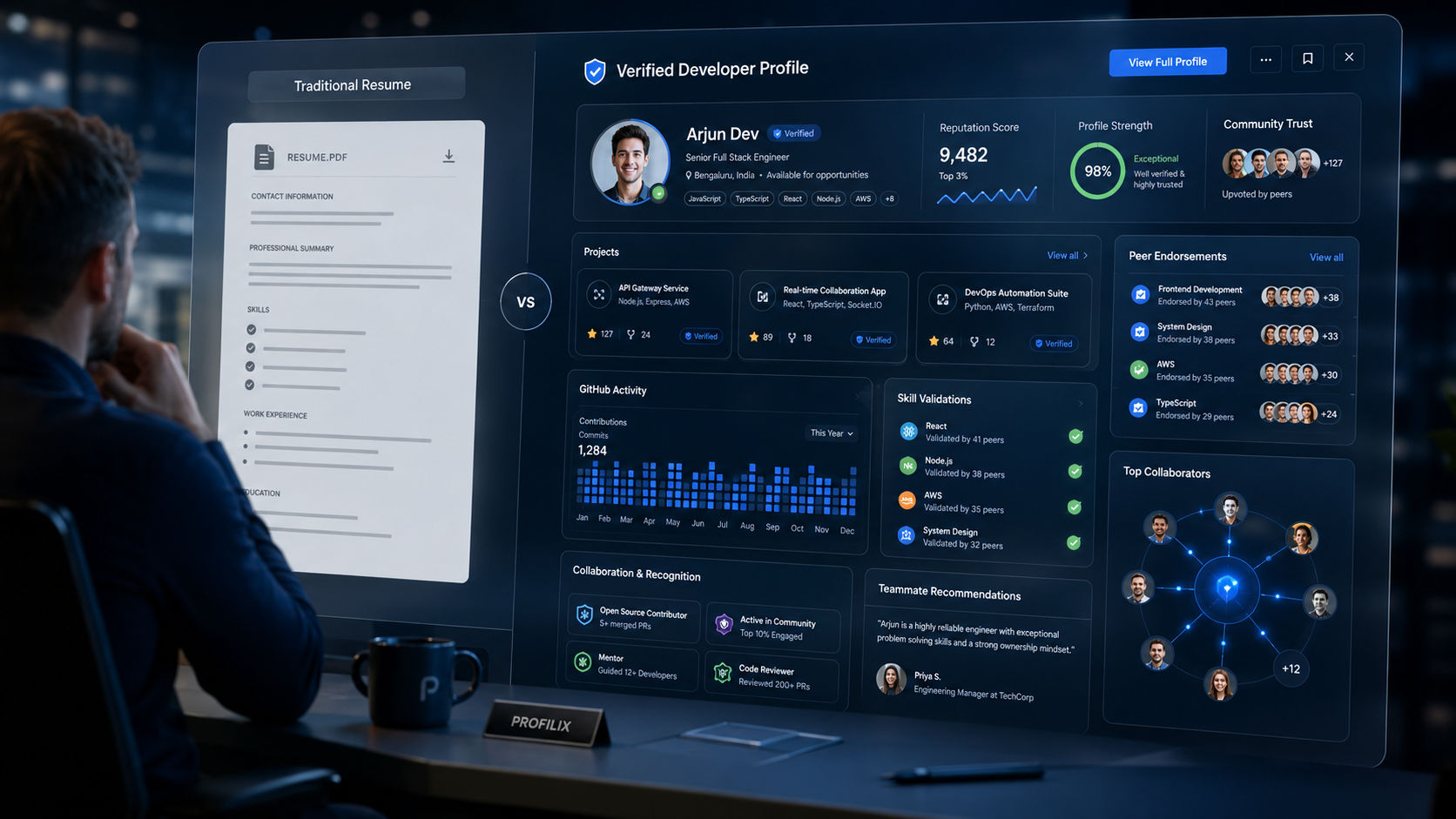
Beyond the Resume: How Peer Endorsements & Upvotes Fast-Track Engineering Trust
Traditional resumes tell recruiters what developers claim they can do. Peer endorsements, community upvotes, and public developer profiles provide stronger signals of credibility, helping engineers build trust and helping hiring managers identify verified talent faster.
In today's hiring market, one problem keeps growing louder on both sides of the interview table:
Trust.
Recruiters struggle to verify whether a resume accurately reflects a candidate's real-world abilities. Developers spend years building meaningful projects and solving difficult engineering challenges, only to have their experience compressed into a few bullet points on a PDF.
The result is a hiring process built largely on self-reported information.
As engineering teams become more distributed and competition for top talent increases, companies are beginning to look beyond traditional resumes. They're searching for stronger signals of credibility, expertise, and impact.
One of the most powerful emerging signals is peer validation through endorsements, recommendations, and community recognition.
For developers, this creates a new opportunity to stand out. For hiring managers, it provides additional confidence when evaluating talent.
Let's explore why peer endorsements are becoming increasingly valuable in modern tech hiring.
The Trust Problem With Traditional Resumes
Resumes have been the standard hiring document for decades.
The challenge is that almost every resume follows the same format:
Self-written achievements
Self-reported skills
Self-assigned expertise levels
Carefully selected project descriptions
A recruiter reviewing hundreds of applications often sees similar claims repeatedly:
"Built scalable systems"
"Led cross-functional teams"
"Expert in React"
"Improved application performance"
While these statements may be completely true, they're difficult to verify without investing significant time in interviews and technical assessments.
PX
Profilix Engineering Desk
Architecting modern developer career workflows
INITIALIZE YOUR INTELLIGENT WORKSPACE
Ready to Accelerate Your Engineering Career?
Compile ATS-ready resumes, sync your GitHub heatmaps, and share a standalone portfolio that stands out to technical recruiters.
This creates a trust gap.
Hiring managers aren't necessarily questioning a developer's honesty. They simply lack enough context to determine which candidates have demonstrated their skills in real engineering environments.
As a result, resumes alone are becoming less effective at differentiating strong candidates from average ones.
Why Social Proof Matters in Engineering
Humans naturally trust information differently depending on its source.
When someone describes their own abilities, we listen.
When other respected professionals validate those abilities, we pay much closer attention.
This concept is known as social proof.
In engineering, social proof can take many forms:
Open-source contributions
Technical recommendations
Community recognition
Peer endorsements
Public project collaborations
Verified testimonials from teammates
These signals provide evidence that other engineers have directly observed a person's work and found it valuable.
Unlike a self-written resume, social proof is harder to manufacture because it requires external validation.
For hiring teams, this additional context can dramatically improve confidence during candidate evaluation.
The Rise of the Developer Portfolio Directory
Modern developers increasingly maintain online profiles that showcase:
Projects
Technical skills
Work history
GitHub activity
Certifications
Community involvement
However, a new trend is emerging beyond the traditional portfolio website:
Developer portfolio directories.
Instead of existing in isolation, developers become part of a broader professional community where peers can discover, evaluate, and interact with each other's profiles.
This changes the nature of professional credibility.
Rather than saying:
"I'm a strong backend engineer."
A developer can demonstrate:
Completed projects
Community participation
Verified collaborations
Peer recognition
Endorsements from other engineers
This creates a much richer picture of technical capability.
What Makes Peer Endorsements Valuable?
Not all endorsements carry equal weight.
The most valuable endorsements come from people who have directly worked with a developer.
Examples include:
Former Teammates
People who have collaborated on production systems understand a developer's technical strengths better than anyone.
Their endorsement reflects real-world performance rather than interview performance.
Open Source Collaborators
Contributors who have reviewed code, discussed architecture decisions, or worked on shared projects can provide meaningful validation.
Hackathon Teammates
Hackathons reveal how engineers operate under pressure.
Endorsements from teammates often highlight problem-solving ability, leadership, communication, and execution.
Technical Community Members
Developers who consistently help others, share knowledge, and contribute to discussions often build strong reputations within professional communities.
These reputational signals become increasingly valuable over time.
Upvotes as Lightweight Trust Signals
Formal endorsements are powerful, but they aren't the only mechanism for establishing credibility.
Community upvotes can also serve as useful trust indicators.
For example, when developers repeatedly receive positive recognition for:
Building impressive projects
Helping other engineers
Sharing technical insights
Contributing to discussions
Solving difficult problems
A pattern begins to emerge.
One upvote means little.
Consistent recognition from dozens of peers over months or years tells a different story.
It suggests that the developer has repeatedly delivered value to a community.
That consistency is often more informative than a single line on a resume.
Why Hiring Managers Pay Attention to Community Reputation
Engineering managers aren't just hiring for technical skills.
They're hiring for:
Collaboration
Communication
Reliability
Learning ability
Team impact
Traditional resumes primarily showcase accomplishments.
Community reputation often showcases behavior.
When a developer earns endorsements from peers, it suggests:
Others enjoy working with them
They contribute positively to teams
Their technical expertise is recognized externally
Their impact extends beyond individual projects
These qualities are difficult to measure through resumes alone.
This is why community-driven credibility signals are becoming increasingly important in modern hiring pipelines.
Building Strong Software Engineer Credentials Beyond a Resume
Developers who want to strengthen their professional reputation should think beyond job titles and technology stacks.
Strong software engineer credentials are often built through a combination of:
Public Projects
Demonstrate what you've actually built.
Consistent Learning
Show growth over time.
Community Participation
Help others and contribute knowledge.
Meaningful Collaborations
Work with talented people and create visible outcomes.
Peer Recognition
Earn endorsements through genuine contributions.
Together, these create a more complete representation of professional capability than any resume can provide alone.
The Future of Trust in Tech Hiring
The future of hiring will likely involve multiple layers of verification.
Resumes won't disappear.
They're still useful for summarizing experience and achievements.
However, recruiters increasingly want supporting evidence that validates those claims.
That evidence may include:
Portfolio projects
GitHub contributions
Technical assessments
Community reputation
Peer endorsements
Public collaboration history
The strongest candidates will be those who combine all of these signals into a cohesive professional identity.
Trust is becoming a competitive advantage.
And trust is rarely built through self-promotion alone.
It's earned through consistent contributions and recognition from peers.
Final Thoughts
The traditional resume is no longer the sole source of truth in technical hiring.
As engineering communities become more connected, peer endorsements, community upvotes, and developer portfolio directories are emerging as powerful indicators of credibility.
For developers, this means your reputation is no longer confined to a PDF.
Every project, collaboration, contribution, and interaction helps build a public record of trust.
For hiring managers, these signals provide additional confidence when identifying exceptional talent.
The future of tech hiring isn't just about what developers say about themselves.
It's increasingly about what other developers say about them.
And in an industry built on collaboration, that may be the strongest signal of all.