A great hackathon idea is important.
A great team is often more important.
Many hackathon projects fail not because the idea is weak, but because the team lacks the right combination of skills. A frontend-heavy team struggles with backend infrastructure. A group of backend developers may have no designer. Sometimes everyone is skilled, but nobody has experience deploying products quickly.
The challenge isn't finding developers.
The challenge is finding the right developers.
Modern developer directories are changing how software engineers discover collaborators, making it easier than ever to find teammates who match specific skills, interests, and project goals.
If you're searching for your next hackathon co-founder, here's how to use directory networking effectively.
Most developers still find teammates through:
- College friend groups
- Existing coworkers
- Discord communities
- Hackathon event channels
- Social media posts
These approaches can work, but they have limitations.
You often know very little about a person's actual experience before committing to a team. Finding someone with the exact skills you need can take days of messaging and screening.
For competitive hackathons, speed matters.
The faster you can identify qualified collaborators, the more time you can spend building.
The Rise of Developer Matchmaking Directories
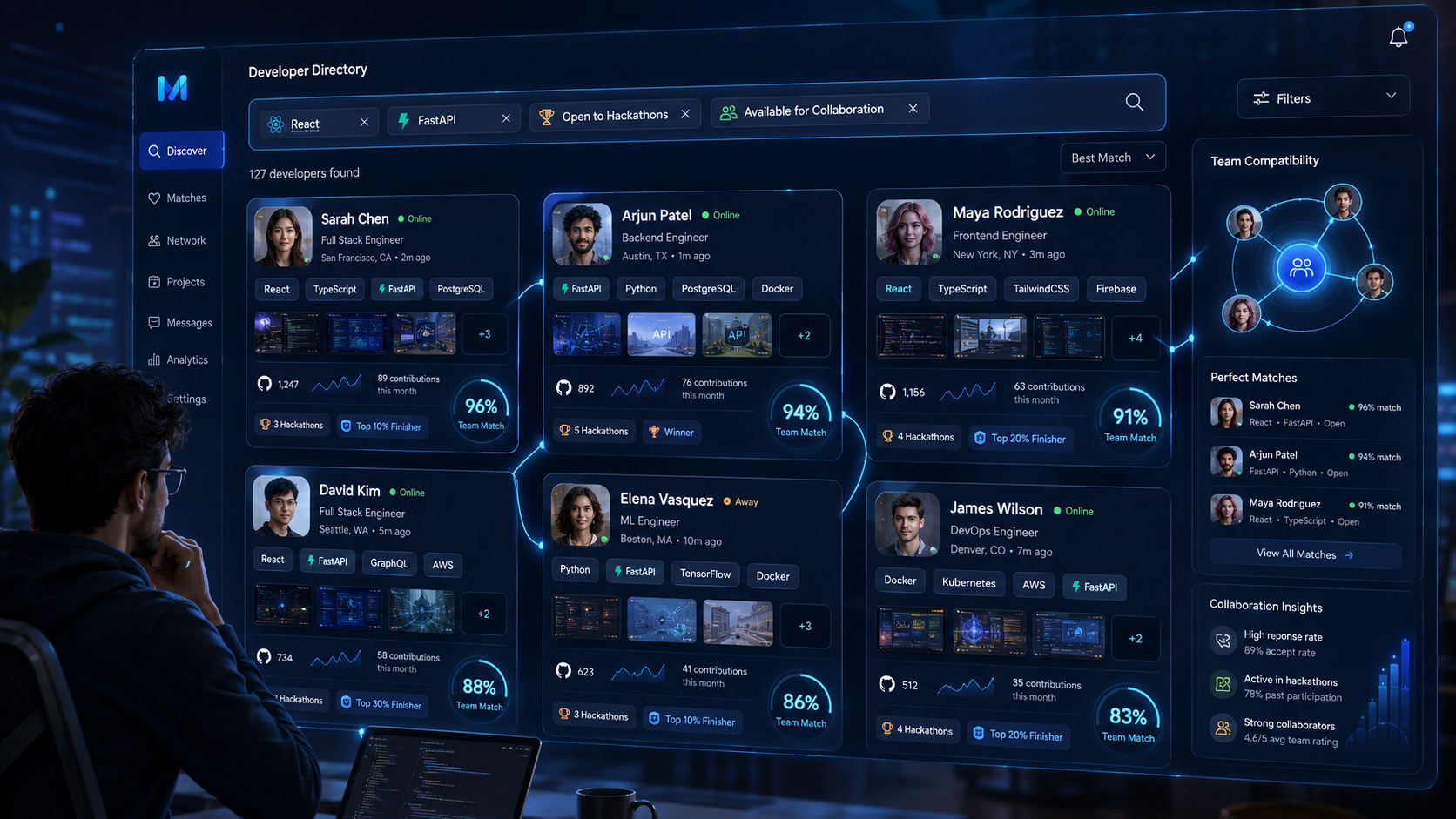
Developer directories provide a searchable database of engineers, designers, builders, and creators.
Unlike traditional social networks, directories focus on discoverability.
You can search based on:
- Programming languages
- Frameworks
- Project experience
- Interests
- Availability
- Open-source contributions
- Hackathon participation
- Geographic location
This transforms networking from random outreach into targeted discovery.
Instead of posting:
"Looking for teammates for an AI hackathon."
You can directly search for:
React developer + FastAPI experience + interested in hackathons.
That's significantly more efficient.
What Makes a Great Hackathon Team?
The best hackathon teams usually combine complementary skills.
Frontend Developer
Responsible for:
- UI implementation
- User experience
- Responsive design
- Client-side interactions
Backend Developer
Responsible for:
- APIs
- Databases
- Authentication
- Infrastructure
AI or Data Specialist
Helpful for:
- LLM applications
- Machine learning
- Recommendation systems
- Data processing
Product and Design Thinker
Responsible for:
- User flows
- Product positioning
- Presentation quality
Not every team needs all four roles, but diversity of skills often leads to stronger outcomes.
How to Search for the Right Developers
Developer directories become powerful when you use specific filters.
Search by Tech Stack
Instead of searching broadly for "JavaScript developers," look for:
- React + TypeScript
- Next.js + Tailwind CSS
- FastAPI + PostgreSQL
- Java + Spring Boot
- MERN Stack
Specific searches produce better matches.
Search by Interests
Many directories allow users to specify interests such as:
- Hackathons
- Open source
- Startup projects
- Freelancing
- AI development
These signals help identify people who are actively seeking collaboration.
Review Portfolio Quality
Don't focus only on skills.
Review:
- Featured projects
- Project complexity
- Deployment links
- GitHub repositories
- Technical writeups
Strong portfolios often reveal more than skill tags alone.
How to Build a Profile Optimized for Discovery
Finding collaborators is only half the equation.
You also want others to discover you.
Use a Clear Headline
Avoid generic descriptions.
Instead of:
Software Developer
Use:
Full-Stack Developer | React, Node.js, PostgreSQL | Open to Hackathons
This improves visibility in search results.
Showcase Relevant Projects
Highlight projects that demonstrate:
- Technical depth
- Team collaboration
- Problem solving
- Product execution
Hackathon participants care about outcomes.
Show what you've built.
Add Collaboration Preferences
Let people know:
- Whether you're open to hackathons
- Preferred project types
- Time availability
- Areas of expertise
The more context you provide, the easier it becomes for others to reach out.
Keep Skills Updated
Many developers forget to update their profiles.
An outdated profile reduces discoverability and can cause missed opportunities.
Reaching Out the Right Way
Once you've found a potential teammate, avoid generic messages.
Bad outreach:
Want to join my hackathon team?
Better outreach:
Hi! I found your profile while searching for React developers interested in hackathons. Your project on real-time collaboration tools stood out. I'm building an AI-powered education project and think your frontend experience would be a great fit.
Personalized outreach dramatically improves response rates.
Evaluating Potential Teammates
Before forming a team, consider:
Technical Fit
Do their skills fill a gap in your team?
Communication
Can they clearly explain their work?
Reliability
Have they completed projects before?
Shared Goals
Are they looking to learn, win prizes, launch startups, or build portfolios?
Alignment matters.
The strongest teams share similar expectations.
Why Directory Networking Will Continue Growing
Developer communities are becoming increasingly global.
Your ideal teammate may not be in your college, company, or city.
They might be on the other side of the world.
Developer directories make those connections possible by allowing engineers to discover each other through skills, interests, and proven work rather than chance encounters.
As hackathons become larger and more competitive, the ability to quickly find high-quality collaborators will become a significant advantage.
Final Thoughts
Finding great teammates shouldn't rely on luck.
Modern developer matchmaking directories make it possible to discover developers online, filter by skills, evaluate portfolios, and connect with people who share your interests.
Whether you're preparing for your next hackathon, launching a side project, or searching for a technical co-founder, investing time in your profile and networking through developer directories can dramatically expand your opportunities.
The next teammate who helps build your best project may already be one search away.