● ENGINEERING DISPATCH•September 12, 2026•10 min read
GitHub vs Portfolio vs Resume: What Should Developers Show Recruiters?
GitHub, a portfolio, and a resume each tell recruiters something different. Learn what developers should include in each, which one matters most, and how to use all three together to stand out during the hiring process.
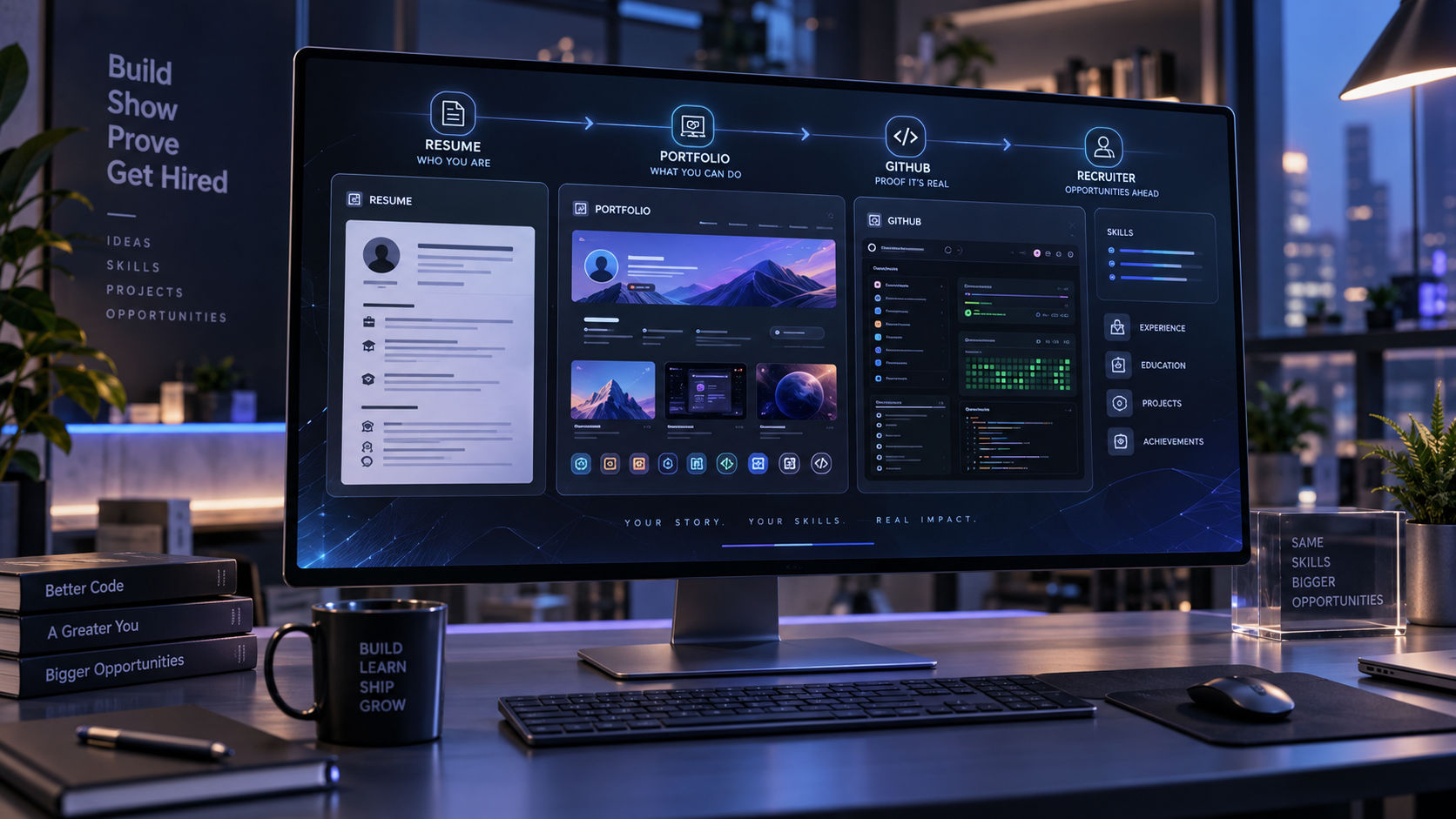
Think of them as three different layers of your professional identity.
Your resume gets attention.
Your portfolio creates context.
Your GitHub provides technical evidence.
What Recruiters Look for in a Resume
Your resume is usually the easiest place for a recruiter to understand your background.
Recruiters often need to quickly determine whether your experience matches the role.
A strong developer resume should include:
PX
Profilix Engineering Desk
Architecting modern developer career workflows
Ready when you are
Your next role starts with a better profile.
Build the portfolio, resume and profile card in one place. Start free, then upgrade only when you need more hosting or AI credits.
Free to startNo credit cardWatermark-free exports
Professional summary
Work experience
Technical skills
Education
Relevant projects
Certifications
Achievements
Links to GitHub and portfolio
The key is to keep the information relevant.
If you're applying for a frontend developer position, your resume should make your frontend experience obvious.
Instead of creating a giant list of every technology you've ever touched, prioritize the technologies and experiences relevant to the position.
Focus on Results
One of the biggest mistakes developers make is describing responsibilities without explaining outcomes.
Instead of:
Developed features for a web application.
Try:
Built and optimized React features used by thousands of monthly users, improving page performance and reducing load time.
The second version tells recruiters much more about your impact.
What Your Portfolio Should Show
Your portfolio gives you more space than a resume.
Instead of compressing everything into one or two pages, you can explain your work visually and in greater depth.
A developer portfolio should typically include:
Introduction
About section
Featured projects
Technical skills
Work experience
Education
Certifications
Case studies
GitHub link
Resume
Contact information
But don't treat your portfolio as an online copy of your resume.
Its job is to show your work rather than simply describe it.
Your Projects Matter More Than the Number of Projects
You don't need 20 projects.
Three to five strong projects can be more effective than a portfolio filled with unfinished experiments.
Choose projects that demonstrate different capabilities.
For example:
Project 1: Full-Stack Application
Demonstrate:
Frontend development
Backend APIs
Database design
Authentication
Deployment
Project 2: Complex Frontend
Demonstrate:
UI architecture
State management
Responsive design
Performance optimization
Accessibility
Project 3: AI Application
Demonstrate:
API integration
LLM workflows
Prompt engineering
Data processing
Evaluation
The projects should collectively tell recruiters what you're capable of building.
What Recruiters Can Learn From GitHub
GitHub is different from a portfolio.
Your portfolio tells recruiters what you want them to see.
GitHub can provide a more direct look at your development work.
Recruiters or technical interviewers may look at:
Repository quality
Code organization
Documentation
Commit history
Project structure
Testing
Issues and pull requests
Open-source contributions
Collaboration
This doesn't mean recruiters will inspect every line of code.
They may only spend a short amount of time looking at your repositories.
That's why your most important repositories should be easy to understand.
Clean Up Your GitHub Profile
If you're using GitHub as part of your job search, spend some time improving it.
Start with your profile.
Add:
Professional profile picture
Short bio
Location, if relevant
Portfolio link
LinkedIn link
Pinned repositories
Then review your repositories.
Archive or hide projects that no longer represent your abilities if appropriate.
For your strongest repositories, make sure they have useful README files.
What a Good README Should Include
A good README can make a surprisingly large difference.
Include:
Project Overview
Explain what the project does.
Problem
Explain why you built it.
Features
Highlight the most important functionality.
Technology
List the major technologies used.
Setup
Explain how someone can run the project locally.
Screenshots
Show the application when visual context is useful.
Demo
Include a live deployment when available.
A recruiter shouldn't have to reverse-engineer your project just to understand what it does.
GitHub Isn't About Having a Perfect Contribution Graph
A common misconception is that recruiters expect developers to have an impressive GitHub contribution graph.
That's not necessarily the case.
A developer with thousands of meaningless commits isn't automatically more impressive than someone with a few well-built projects.
Quality matters.
A small number of thoughtfully designed repositories can communicate more than a wall of activity.
So Which One Matters Most?
There isn't a universal winner.
It depends on where you are in the hiring process.
During Initial Screening
Your resume usually matters most.
Recruiters need to quickly determine whether your background matches the job.
When Evaluating Your Work
Your portfolio becomes more valuable.
It gives recruiters and hiring managers an easy way to understand your projects and capabilities.
During Technical Evaluation
Your GitHub can become more useful.
Technical interviewers may use it to understand your coding style, project organization, documentation, and engineering practices.
This creates a natural progression:
Resume → Portfolio → GitHub
What Should Students Show?
Students often don't have extensive professional experience.
That's okay.
Your portfolio and GitHub can compensate for limited work experience by demonstrating what you can actually build.
Focus on:
Academic projects
Personal projects
Hackathon projects
Open-source contributions
Internships
Freelance work
Technical experiments
Research projects
For each project, explain your contribution and what you learned.
Don't apologize for not having years of experience.
Use your projects as evidence of your ability to learn and build.
What Should Experienced Developers Show?
If you already have several years of professional experience, your resume should generally receive more emphasis.
Your professional accomplishments become your strongest evidence.
Highlight:
Products you've worked on
Systems you've designed
Performance improvements
Leadership
Architecture decisions
Team collaboration
Business impact
Mentoring
Open-source contributions
Your portfolio can then provide deeper context for selected projects.
You don't need to showcase every internal project you've worked on, especially when confidentiality prevents you from doing so.
What If You Don't Have a Portfolio?
You don't necessarily need a highly elaborate website.
A simple portfolio can be enough.
At minimum, create a page containing:
Short introduction
Three strong projects
Skills
Experience
Resume
GitHub
Contact information
The goal isn't to win a design award.
The goal is to make your professional story easy to understand.
What If Your GitHub Isn't Very Active?
Don't panic.
GitHub activity isn't the only indicator of technical ability.
If your professional work is private, that's normal.
Instead, focus on creating a few public repositories that demonstrate relevant skills.
You can also showcase:
Personal projects
Open-source contributions
Technical articles
Small tools
Libraries
Experiments
Don't create artificial activity simply to make your contribution graph look busy.
Don't Let Design Hide Your Work
A visually impressive portfolio can attract attention.
But excessive animations, complicated navigation, and heavy visual effects can make it harder for recruiters to find what matters.
Your design should support your content.
Make sure visitors can quickly find:
Who you are → What you build → Your best projects → Your experience → How to contact you
Everything else is secondary.
Connect All Three
Your resume, portfolio, and GitHub should not exist independently.
Connect them.
Your resume should link to your portfolio and GitHub.
Your portfolio should link to your resume and GitHub.
Your GitHub profile should link back to your portfolio.
This creates a consistent professional identity across platforms.
For example:
Resume
→ Portfolio
→ GitHub
Portfolio
→ Resume
→ GitHub
→ LinkedIn
GitHub
→ Portfolio
→ Professional profile
A recruiter who discovers you through any one of these channels should be able to find the others easily.
Keep Everything Consistent
One subtle issue that can hurt your credibility is inconsistent information.
Make sure your:
Job titles
Employment dates
Project names
Technology lists
Education details
Contact information
are consistent across your resume, portfolio, and professional profiles.
If your resume says you worked with React for three years but your portfolio presents completely different technologies, recruiters may have questions.
Your online presence should tell one coherent story.
What About LinkedIn?
LinkedIn isn't a replacement for your resume, portfolio, or GitHub.
Think of it as another layer of your professional presence.
Your LinkedIn profile can help recruiters discover you and understand your professional background.
A useful setup is:
LinkedIn → Professional network and discovery
Resume → Concise career summary
Portfolio → Projects and professional presentation
GitHub → Technical evidence
Each platform has a different job.
A Simple Developer Job Search Stack
If you want to keep things simple, build these four assets:
1. Resume
Keep it concise and focused on measurable achievements.
2. Portfolio
Show your strongest projects and explain how you built them.
3. GitHub
Keep your best repositories organized and documented.
4. LinkedIn
Keep your professional profile updated and consistent.
You don't need to spend months building an elaborate personal brand.
You need a professional presence that makes your skills easy to verify.
The Best Combination
Instead of asking:
"Should I focus on GitHub, my portfolio, or my resume?"
Ask:
"How can I make all three tell the same story?"
Your resume should make recruiters interested.
Your portfolio should make them curious about your work.
Your GitHub should give technical evidence.
Together, they create a much stronger picture of you as a developer.
Final Takeaway
GitHub, portfolios, and resumes aren't competing tools.
They're complementary.
Your resume tells recruiters where you've been.
Your portfolio shows what you've built.
Your GitHub demonstrates how you work with code.
If you're applying for developer roles in 2026, you don't need to make every platform perfect.
Start with a strong resume, create a focused portfolio, and make sure your best GitHub repositories are clean and documented.
Then connect everything together.
The goal isn't to show recruiters everything you've ever done.
It's to make your best work, strongest skills, and professional experience easy to discover and understand.