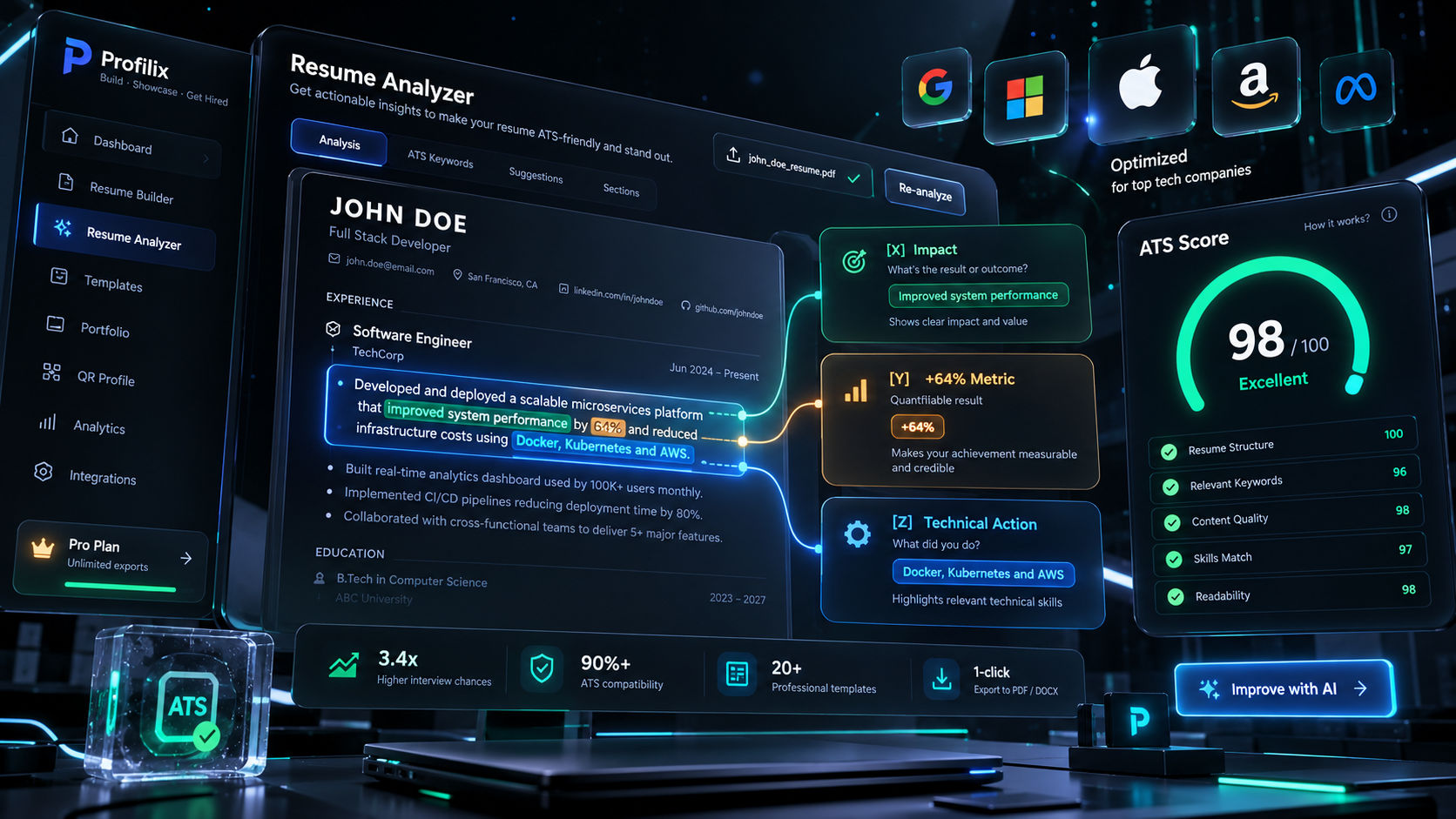
The Google XYZ Formula: How to Write Engineering Resume Bullets That Land FAANG Interviews
Why do some software engineers with average project experience land interviews at Google, Meta, and Amazon, while others with strong technical skills get auto-rejected? Nine times out of ten, the difference comes down to how their resume bullet points are structured.
Most developers write their resumes like a job description: "Built REST APIs using Node.js," or "Worked on the frontend checkout page in React." These statements tell a recruiter what you were assigned to do, not how well you did it or why it mattered.
To stand out in a pile of thousands of applicants, Google’s former Senior Vice President of People Operations, Laszlo Bock, popularized a deceptively simple framework known as the Google XYZ Formula. Here is how it works and how you can apply it to every line of your engineering resume.
The formula structures every single bullet point around three distinct pillars:
Accomplished [X] as measured by [Y], by doing [Z].
- [X] The Impact / Achievement: What did you actually accomplish or improve? (e.g., Reduced API latency, increased test coverage, accelerated deployment times).
- [Y] The Quantitative Metric: How do you prove that impact with numbers? (e.g., by 42%, from 1.2s to 300ms, saving 15 engineering hours per week).
- [Z] The Technical Action / How: What specific technologies, architectures, or algorithms did you implement to make it happen? (e.g., by implementing a Redis caching layer and optimizing PostgreSQL indexing).
Why does this work so well? Because technical recruiters spend an average of 6 to 8 seconds scanning a resume. The XYZ formula front-loads the business value (X and Y) for the recruiter and packs the concrete engineering proof (Z) for the hiring manager.
Real-World Before & After Examples for Engineers
Let’s look at how standard, forgettable developer bullets transform when rewritten using the XYZ framework across different domains:
1. Backend & Systems Engineering
- Weak (Task-focused): Wrote backend endpoints in FastAPI and used Redis for caching database queries.
- Strong (XYZ Formula): Reduced p99 API response latency (X) by 64% from 850ms to 305ms under 10k RPM load (Y), by refactoring N+1 PostgreSQL queries and implementing a write-through Redis caching layer in FastAPI (Z).
- Weak (Task-focused): Developed a 3D interactive landing page using React and Three.js.
- Strong (XYZ Formula): Improved landing page conversion rate (X) by 18% and boosted Google Lighthouse performance scores from 62 to 96 (Y), by implementing React code-splitting, Draco 3D mesh compression, and lazy-loaded WebGL canvases (Z).
3. DevOps & Cloud Infrastructure
- Weak (Task-focused): Set up CI/CD pipelines using GitHub Actions and Docker for microservice deployment.
- Strong (XYZ Formula): Accelerated production release velocity (X) by cutting deployment times from 45 minutes to 6 minutes (Y), by containerizing 8 microservices with multi-stage Docker builds and automating parallel test suites via GitHub Actions (Z).
4. Hackathons & Academic Projects
- Weak (Task-focused): Built an AI fact-checking app in a hackathon with two teammates.
- Strong (XYZ Formula): Won 2nd place among 85 competing teams (X) with an AI video verification platform capable of processing 60-second clips in under 4 seconds (Y), by orchestrating an async Python pipeline using Whisper ASR and RAG vector search (Z).
"Wait, What If I Don't Have Exact Metrics for [Y]?"
Many student developers and junior engineers struggle with the [Y] component because they weren't given access to company revenue numbers or Google Analytics dashboards. You don't need financial metrics to quantify your engineering work. Measure what you can control:
- Performance & Latency: Compare payload size, Lighthouse scores, memory footprint, or query execution time before and after your code change (
console.time(), Chrome DevTools, or EXPLAIN ANALYZE).
- Scale & Volume: Mention the scale of the system—number of concurrent users, database rows, API requests per second, or components migrated.
- Developer Productivity: Did your script or reusable UI component library save your team from manual work? Quantify the time saved (e.g., "eliminated 6 hours of manual QA testing per sprint").
- Reliability & Quality: Track unit test coverage increases (e.g., "increased Jest test coverage from 48% to 88%") or bug ticket reductions.
High-Impact Action Verbs to Start Your Bullets
Never start a bullet point with "Responsible for," "Helped," or "Worked on." Lead with strong engineering action verbs:
- For Speed & Efficiency: Accelerated, Optimized, Reduced, Eliminated, Compressed, Streamlined.
- For Building & Architecture: Architected, Engineered, Spearheaded, Designed, Orchestrated, Deployed.
- For Reliability & Scale: Scaled, Automated, Fortified, Migrated, Refactored, Standardized.
Quick Checklist Before You Export to PDF
- Keep Each Bullet to 1–2 Lines: A 4-line paragraph is a wall of text, not a bullet point. Trim filler words.
- Avoid Keyword Stuffing: Integrate your tech stack naturally inside the [Z] section rather than dumping a laundry list of tools at the end of a sentence.
- Use Single-Column ATS Layouts: Even the best XYZ bullets won't land an interview if a multi-column graphic template scrambles your text inside an Applicant Tracking System (ATS). Keep your formatting clean, structured, and machine-readable.