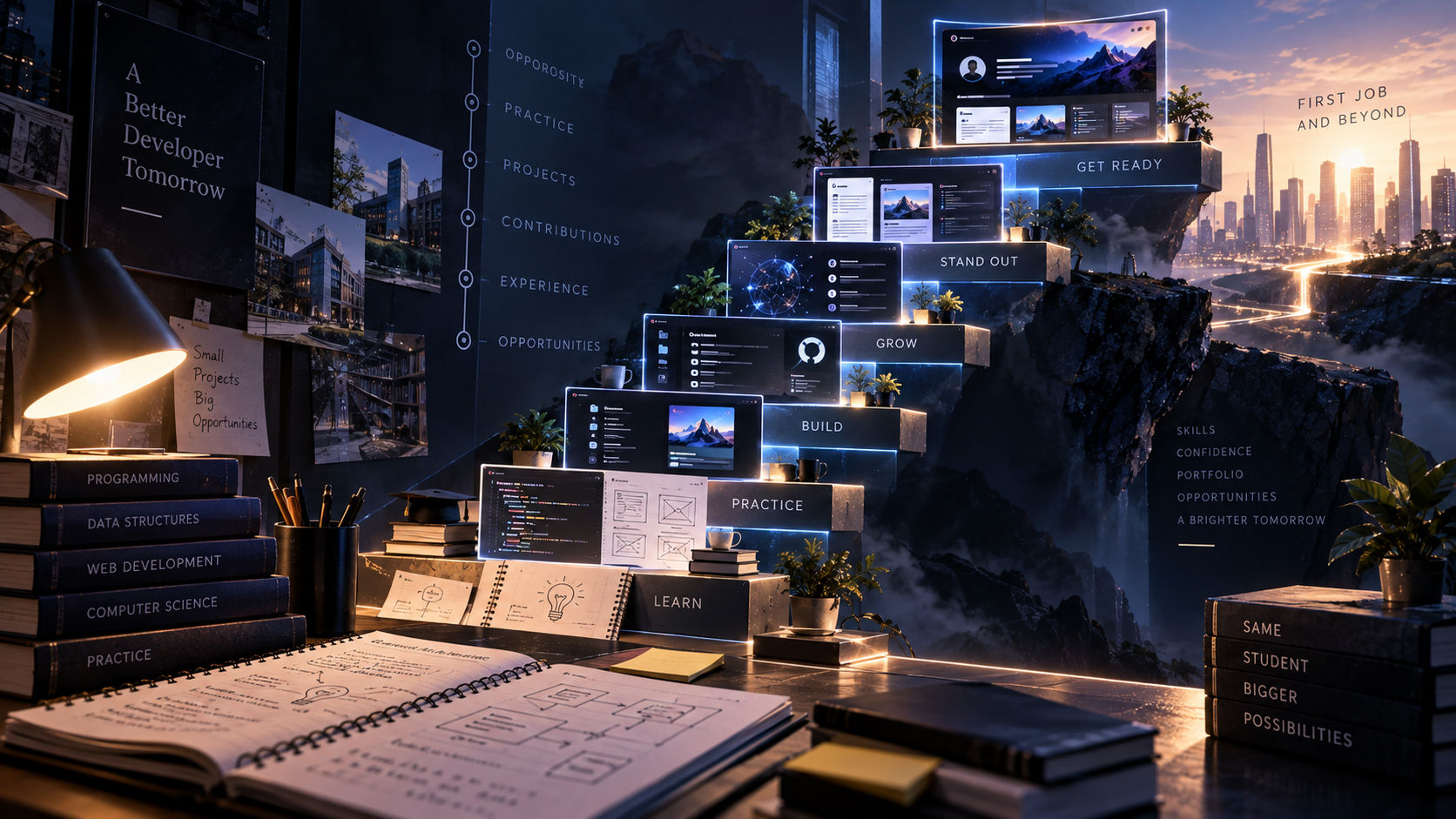
How Students Can Build a Strong Developer Portfolio Before Their First Job
One of the biggest challenges students face when applying for their first developer role is a frustrating question:
"How do I get experience if every job asks for experience?"
The answer isn't to wait until you get your first job to start building your professional profile.
You can start building evidence of your skills before your first full-time role.
A strong student developer portfolio can demonstrate what you know, what you've built, how you solve problems, and how seriously you take software development.
You don't need five years of experience.
You need proof that you can learn, build, and finish things.
Here's how to build that proof.
1. Don't Wait Until Graduation
A common mistake is waiting until the final semester to create a portfolio.
By then, you may have:
- Several projects
- Coursework
- Hackathons
- GitHub repositories
- Internships
- Certifications
But everything is scattered.
Start early.
Even a first-year student can create a simple portfolio containing:
- Introduction
- Skills
- Projects
- GitHub
- Education
- Contact
Then update it throughout college.
By graduation, you'll have a professional record of your development journey.
2. Start With the Projects You Already Have
You probably already have projects.
They might be:
- College assignments
- Small web applications
- Scripts
- Mobile apps
- Hackathon projects
- Course projects
- Experiments
- Automation tools
Don't immediately dismiss them because they weren't built for a company.
Instead, identify which ones demonstrate useful skills.
A basic project can become more interesting when you explain:
- Why you built it
- What problem it solves
- What you learned
- What technologies you used
- What challenges you encountered
3. Build Three Strong Projects
You don't need 20 projects.
Aim for around three strong projects that demonstrate different abilities.
For example:
Project 1: Full-Stack Application
Demonstrate:
- Frontend
- Backend
- Database
- Authentication
- Deployment
Project 2: Technical Project
Demonstrate:
- APIs
- Data processing
- Algorithms
- Performance
- Architecture
Project 3: Creative or Interesting Project
Demonstrate:
- Product thinking
- UI
- New technology
- AI
- Automation
Three well-explained projects can create a much stronger portfolio than 15 unfinished projects.
4. Build Something People Can Actually Use
Tutorial projects are useful for learning.
But building something yourself is much more valuable for a portfolio.
Instead of another:
"To-do list built with React."
try building something around a real problem.
For example:
- Campus event platform
- Student expense tracker
- Internship application tracker
- Study planner
- College club management system
- Developer resource directory
- AI study assistant
- Local business booking system
The idea doesn't need to become a startup.
It simply needs to solve a real problem.
5. Turn Problems Around You Into Project Ideas
Look around.
What problems do students regularly experience?
Maybe:
- Finding campus events is difficult.
- Students struggle to track assignments.
- Clubs manage registrations manually.
- Notes are scattered across different platforms.
- Students don't know where to find internships.
These problems can become excellent projects.
Instead of asking:
"What project should I build?"
ask:
"What problem do I encounter that software could improve?"
That question usually produces better ideas.
6. Don't Build Projects Just to Add Technologies
Avoid creating projects solely because you want another technology on your resume.
For example:
"I need a project using MongoDB."
That's backwards.
Start with a problem.
Then choose the technology that makes sense.
Your project should demonstrate:
Problem → Solution → Technology
not:
Technology → Find Something to Build
This also makes your project explanation much more convincing during interviews.
7. Make Your GitHub Look Professional
Your GitHub profile can be valuable when you don't have professional experience.
Start by:
- Adding a profile photo
- Writing a short bio
- Linking your portfolio
- Pinning your strongest repositories
- Cleaning up old repositories
- Improving important README files
You don't need hundreds of repositories.
A few well-maintained projects are enough.
8. Write Good README Files
A recruiter shouldn't have to figure out what your project does.
For important repositories, include:
Overview
What is the project?
Features
What can users do?
Technology
What did you use?
Installation
How can someone run it?
Screenshots
What does it look like?
Demo
Can someone try it?
Lessons
What did you learn?
A good README can make a student project feel much more professional.
9. Add Live Demos
If possible, deploy your projects.
A recruiter can learn much more from:
Try the application
than:
Here's 2,000 lines of source code.
A live demo also shows that you can take a project beyond development and actually get it running.
Depending on the project, you can include:
- Live website
- Demo account
- Video walkthrough
- GitHub repository
10. Explain Your Contribution
If a project was created as part of a team, clearly explain what you did.
For example:
"Worked with three students to build a campus event platform. I designed the React frontend, implemented authentication, and integrated the application with the backend API."
This is much better than:
"Built a campus event platform with my team."
Recruiters want to know your contribution.
11. Participate in Hackathons
Hackathons can be excellent portfolio material.
They demonstrate that you can:
- Work under deadlines
- Collaborate
- Learn quickly
- Build prototypes
- Solve problems
- Present ideas
If you participate in a hackathon, don't just add:
"Participated in XYZ Hackathon."
Explain what you built.
For example:
"Built an AI-powered accessibility assistant during a 36-hour hackathon, working with a three-person team to prototype the application from concept to working demo."
That's much more meaningful.
12. Contribute to Open Source
You don't need to become a major open-source contributor.
Start small.
You can contribute through:
- Documentation
- Bug fixes
- Tests
- Small features
- Issue discussions
- Code improvements
Open source can demonstrate that you can work with code you didn't write yourself.
That's an important professional skill.
13. Document What You're Learning
You don't need to be an expert to write.
You can document your learning journey.
For example:
"What I learned building my first REST API."
"Three mistakes I made while learning React."
"How I deployed my first application."
"What I learned about PostgreSQL relationships."
This content can become part of your portfolio.
It also demonstrates communication skills.
14. Create Case Studies for Your Best Projects
A project screenshot isn't enough.
For your strongest project, create a detailed case study.
Include:
The Problem
What were you trying to solve?
The Idea
Why did you choose this approach?
Implementation
How did you build it?
Challenges
What went wrong?
Solution
How did you fix it?
Result
What did you accomplish?
Lessons
What would you do differently?
This can make a student project look much more substantial.
15. Show Your Learning Progress
You don't need to pretend you're already a senior engineer.
Show your progression.
For example:
2025
Started learning JavaScript.
↓
2025
Built first React application.
↓
2026
Built full-stack applications.
↓
2026
Started contributing to open source.
↓
2026
Built and deployed production-style projects.
This tells a story.
And recruiters can see that you're actively developing your skills.
16. Include Your Education
As a student, education is relevant.
Include:
- University
- Degree
- Field of study
- Expected graduation
- Relevant coursework
- Academic achievements
You don't need to turn your portfolio into an academic transcript.
Keep it focused.
17. Include Relevant Certifications
Certifications aren't a replacement for projects.
But they can support your portfolio.
Examples include:
- Cloud certifications
- Programming certifications
- Database certifications
- Technical courses
- Industry certifications
Choose certifications that are relevant to the roles you're targeting.
18. Show Your Technical Stack Clearly
Don't list every technology you've ever used.
Instead, organize your strongest skills.
For example:
Frontend
React · TypeScript · Next.js
Backend
Node.js · Express
Database
PostgreSQL · MongoDB
Git · GitHub · Docker
Your projects should provide evidence for these skills.
19. Include Your Resume
Even if you're a student, have a resume available.
Your resume should include:
- Education
- Projects
- Technical skills
- Internships
- Hackathons
- Open-source contributions
- Achievements
Keep it concise.
Your portfolio provides depth.
Your resume provides a quick summary.
Don't make recruiters search for your email.
Include an obvious contact section.
For example:
Let's Connect
Email
LinkedIn
GitHub
If you're actively looking for internships or entry-level roles, say so.
21. Don't Hide Your Student Status
Being a student isn't a weakness.
It's context.
Instead of trying to appear like a senior engineer, position yourself honestly.
For example:
"Computer science student focused on full-stack development and AI applications."
That immediately tells recruiters what stage you're at and what you're interested in.
22. Focus on Proof, Not Claims
One of the most important principles for a student portfolio is:
Show, don't just tell.
Don't write:
"I'm an excellent React developer."
Show:
React
→ Project
→ Live demo
→ GitHub
→ Case study
That's evidence.
The same applies to almost every skill.
23. Avoid the Tutorial Portfolio
A portfolio filled with tutorial clones can be difficult to evaluate.
Examples include:
- Netflix clone
- YouTube clone
- Basic weather app
- Basic calculator
- Basic to-do app
These projects are fine for learning.
But they shouldn't necessarily be the centerpiece of your portfolio.
Take the next step.
Modify them.
Add meaningful functionality.
Solve a real problem.
Make the project your own.
24. Build One Project Deeply
You don't need every project to be huge.
Consider taking one project and going deeper.
For example:
Basic application
↓
Authentication
↓
Database
↓
Payments
↓
Caching
↓
Testing
↓
Deployment
↓
Monitoring
↓
Performance optimization
This can demonstrate much more engineering ability than several tiny applications.
25. Make Your Portfolio Mobile-Friendly
Recruiters may open your website from their phone.
Make sure:
- Text is readable
- Navigation works
- Buttons are easy to tap
- Images aren't broken
- Projects display correctly
- There is no horizontal scrolling
A broken mobile layout can make an otherwise strong portfolio feel unfinished.
26. Don't Overdesign It
Your portfolio doesn't need:
- Huge 3D animations
- Complicated loading screens
- Dozens of gradients
- Excessive particles
- Animated cursors
- Complex transitions
A simple, polished website is enough.
Your projects should be the focus.
27. Get Feedback
Before sending your portfolio to recruiters, ask someone else to review it.
Ask them:
"What do you think I do?"
"Which project stands out?"
"Could you find my GitHub?"
"Could you find my resume?"
"How would you describe me after visiting this site?"
If they struggle to answer, improve the website.
28. Keep Updating It
Your portfolio shouldn't be a one-time college assignment.
Update it when you:
- Finish a project
- Complete an internship
- Win a hackathon
- Make an open-source contribution
- Earn a certification
- Publish an article
- Learn an important technology
By graduation, your portfolio can become one of your strongest career assets.
What Recruiters Actually Need From a Student Portfolio
Recruiters don't expect students to have ten years of experience.
They're looking for evidence of:
Curiosity
Do you learn outside the classroom?
Initiative
Do you build things on your own?
Technical Ability
Can you actually implement what you claim?
Problem Solving
Can you explain how you approached difficult problems?
Communication
Can you explain your work clearly?
Growth
Are you improving over time?
Your portfolio can demonstrate all of these.
A Strong Student Portfolio Structure
A simple structure could look like:
Home
│
├── Introduction
│
├── Featured Projects
│
├── Skills
│
├── Experience / Internships
│
├── Education
│
├── Certifications
│
├── GitHub
│
├── Resume
│
└── Contact
You can add:
- Blog
- Open source
- Hackathons
- Achievements
- Case studies
as your experience grows.
A Student Portfolio Checklist
Before applying for your first job, make sure your portfolio has:
Profile
- Clear name
- Developer role
- Short introduction
- Professional photo or avatar
Projects
- 3–5 strong projects
- Project screenshots
- Clear descriptions
- Technology stack
- Live demos
- GitHub links
Experience
- Internships
- Freelance work
- Team projects
- Relevant volunteering
Education
- University
- Degree
- Expected graduation
Additional Proof
- GitHub
- Open source
- Hackathons
- Certifications
- Technical writing
- Email
- LinkedIn
- GitHub
- Resume
Your First Job Doesn't Define Your Portfolio
One of the biggest advantages of starting early is that you don't have to wait for a company to give you experience.
You can create your own evidence.
Build a project.
Deploy it.
Document it.
Contribute to open source.
Write about what you learned.
Participate in hackathons.
Improve your GitHub.
Every one of these becomes another piece of evidence.
Eventually, your portfolio tells a story:
This person started learning, built things, kept improving, and is ready for the next step.
That's exactly the story you want recruiters to see.
Final Thoughts
You don't need a job to start building a developer portfolio.
You need something more fundamental:
evidence of your ability to learn and build.
Start with the projects you already have.
Then build a few projects around real problems.
Document them.
Put the best ones on GitHub.
Deploy them when possible.
Write case studies.
Contribute to open source.
Keep your portfolio updated.
And don't worry about making it look like the portfolio of a senior engineer.
Your portfolio should accurately represent where you are today while showing where you're going.
By the time your first job application arrives, you shouldn't be starting from zero.
You should already have a body of work that gives recruiters a reason to take a closer look.