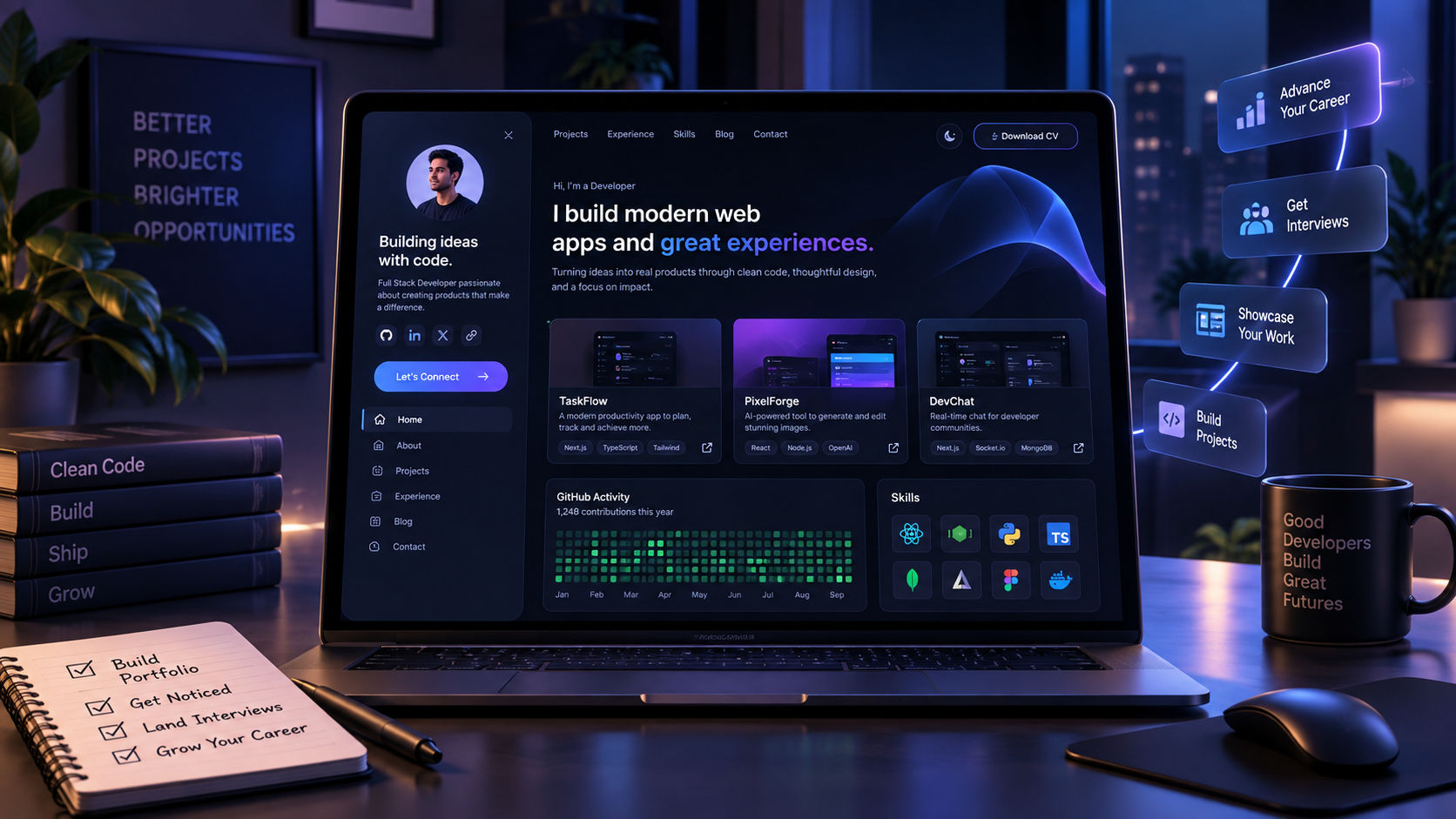
How to Build a Developer Portfolio That Actually Gets You Interviews
A developer portfolio is more than a collection of projects, technologies, and a fancy landing page.
Done right, it gives recruiters and hiring managers a quick answer to one important question:
“Can this developer actually build things?”
The problem is that many developer portfolios fail to communicate that.
They list 25 technologies, showcase tutorial projects, include a generic bio, and spend more time on animations than on demonstrating real engineering ability.
A strong portfolio does the opposite.
It makes your skills obvious, your projects credible, and your experience easy to understand.
Here's how to build one that can actually help you get interviews.
1. Start With a Clear Developer Identity
The first few seconds matter.
When someone lands on your portfolio, they should immediately understand:
- Who you are
- What you build
- What technologies you work with
- What kind of opportunities you're looking for
Avoid generic headlines such as:
"Welcome to my portfolio."
or:
"I'm a passionate developer who loves coding."
They don't tell the visitor anything useful.
Instead, make your positioning specific.
For example:
Full-Stack Developer building scalable web products with React, Node.js, and PostgreSQL.
Or:
Frontend Developer focused on building fast, accessible, and polished web experiences.
Or:
Software Engineer building AI-powered products and developer tools.
Your introduction should make your professional direction obvious without requiring the visitor to dig through your entire portfolio.
2. Treat Your Portfolio Like a Product
Your portfolio itself is also a demonstration of your engineering ability.
If you're applying for a frontend role, the portfolio should demonstrate strong frontend work.
If you're applying for a backend role, your projects should communicate architecture, APIs, databases, scalability, and engineering decisions.
If you're applying for full-stack positions, demonstrate both.
This means the portfolio should have:
- Fast loading times
- Responsive design
- Good typography
- Clear navigation
- Accessible interactions
- Sensible information hierarchy
- Working links
- No broken sections
- Good mobile experience
A beautiful portfolio that takes five seconds to load is still a bad portfolio.
A simple portfolio that loads instantly and clearly communicates your work can be far more effective.
3. Put Your Best Projects First
Your projects are usually the most important part of a developer portfolio.
But don't make the mistake of adding everything you've ever built.
Three excellent projects are usually more convincing than fifteen mediocre ones.
Choose projects that demonstrate different aspects of your abilities.
For example:
Project 1: A Real Product
Show something that solves an actual problem.
Explain:
- What problem it solves
- Who uses it
- What you built
- Your technical decisions
- The challenges you encountered
- The outcome
Project 2: A Technically Interesting Project
This could demonstrate:
- Complex backend architecture
- Real-time systems
- AI integration
- Performance optimization
- Distributed systems
- Advanced frontend interactions
Project 3: A Project That Shows Range
Use this project to demonstrate another important skill.
For example, if your first two projects are frontend-heavy, your third project could demonstrate backend development, database design, automation, or infrastructure.
The goal isn't to show how much you can build.
The goal is to show what you're capable of building.
4. Don't Just List Technologies. Explain What You Did With Them.
One of the most common portfolio mistakes is a giant technology list:
React • Next.js • Node.js • MongoDB • PostgreSQL • Docker • AWS • Python • TypeScript • Redis • Git
That doesn't prove much.
Anyone can add a technology to a list.
Instead, connect technologies to actual work.
For example:
PostgreSQL
Designed the relational data model for users, projects, subscriptions, and usage tracking.
Or:
Redis
Implemented caching and rate limiting to reduce repeated database operations.
Or:
React
Built a reusable component system with responsive layouts and optimized rendering.
This gives recruiters evidence rather than claims.
5. Tell the Story Behind Every Important Project
A project becomes much more impressive when you explain the engineering decisions behind it.
Instead of:
Built an e-commerce website using React and Node.js.
Write something closer to:
Built a full-stack e-commerce platform supporting product discovery, authentication, cart management, payments, and order tracking. Designed the API layer with Node.js and PostgreSQL and implemented a responsive React frontend.
Then go deeper.
The Problem
What were you trying to solve?
Your Approach
How did you decide to solve it?
Technical Challenges
What was difficult?
Engineering Decisions
Why did you choose a particular database, framework, architecture, or API?
Result
What happened after you built it?
This transforms a project from a screenshot into evidence of engineering ability.
6. Show Real Results Whenever Possible
Numbers make projects much more credible.
Instead of:
Improved website performance.
Try:
Reduced average page load time from 3.2s to 1.4s.
Instead of:
Built an API used by users.
Try:
Designed and deployed an API handling 10,000+ requests per day.
Instead of:
Improved database performance.
Try:
Reduced a frequently executed query from approximately 800ms to under 100ms through indexing and query optimization.
You don't need impressive numbers.
You need real numbers.
If a project has no meaningful metrics, describe the outcome honestly.
7. Include Live Projects
Whenever possible, let people actually use what you built.
A project card should ideally include:
- Live Demo
- Source Code
- Case Study or Details
For example:
AI Resume Analyzer
Upload a resume and receive structured feedback on skills, experience, and job alignment.
Tech: Next.js, TypeScript, PostgreSQL, OpenAI API
Links: Live Demo · GitHub · Case Study
A recruiter shouldn't have to search for your project.
Make it one click away.
8. Make Your GitHub Part of the Portfolio
Your portfolio gets someone interested.
Your GitHub can provide supporting evidence.
You don't need a perfectly curated GitHub profile with hundreds of repositories.
Focus on quality.
For important repositories:
- Write a useful README
- Explain what the project does
- Include setup instructions
- Explain the architecture
- Document important technical decisions
- Add screenshots when useful
- Keep the code organized
- Remove unnecessary secrets and configuration files
A strong README can turn a repository into a miniature technical case study.
9. Make Your Experience Easy to Scan
Recruiters often don't read every word.
Design your experience section so someone can understand your background quickly.
For each role, show:
Company
Role · Dates
Then focus on accomplishments rather than responsibilities.
Weak:
Worked on the company's frontend application.
Better:
Built reusable React components used across 12 product workflows and reduced duplicated UI code across the application.
Weak:
Worked with the backend team.
Better:
Developed REST APIs for authentication, billing, and user management using Node.js and PostgreSQL.
The difference is simple:
Responsibilities describe what you were assigned.
Achievements describe what you actually accomplished.
10. Keep Your Tech Stack Relevant
You don't need to list every technology you've touched.
If your portfolio says you know 40 technologies, recruiters may assume you know each one superficially.
Instead, organize your skills.
Languages
TypeScript, JavaScript, Python, SQL
Frontend
React, Next.js, Tailwind CSS
Backend
Node.js, Express, REST APIs
Databases
PostgreSQL, Redis, MongoDB
Infrastructure
Docker, AWS, GitHub Actions
This is easier to understand and much more credible.
11. Add Proof Beyond Your Portfolio
A portfolio shouldn't exist in isolation.
Connect it to the rest of your professional presence.
Useful links include:
- GitHub
- LinkedIn
- X
- Email
- Personal blog
- Open-source contributions
- Technical writing
- Certifications
- Relevant communities
The goal is to create a consistent professional identity.
Your portfolio says what you can do.
Your GitHub shows what you've built.
Your writing can demonstrate how you think.
Your LinkedIn provides professional context.
Together, they create a much stronger signal.
12. Write About What You Build
Technical writing is an underrated way to stand out.
You don't need to become a full-time blogger.
Write about things you genuinely worked on.
For example:
- How I designed the architecture for my SaaS application
- What I learned migrating from MongoDB to PostgreSQL
- How I reduced API response times
- Building authentication with Next.js
- Lessons from deploying my first production application
- How I integrated AI into my application
A good technical article demonstrates something a list of technologies never can:
how you think.
13. Don't Overdesign Your Portfolio
There's nothing wrong with a visually impressive portfolio.
But design should support the content.
Avoid:
- Excessive animations
- Difficult navigation
- Huge blocks of text
- Unnecessary 3D effects
- Auto-playing audio
- Hidden project information
- Slow-loading backgrounds
- Tiny text
- Overly complicated interactions
Your portfolio should feel polished, not distracting.
Think:
“How quickly can someone understand my work?”
Not:
“How many effects can I fit on this page?”
14. Optimize for Mobile
Recruiters and hiring managers don't always view portfolios on large desktop monitors.
Open your portfolio on your phone.
Check:
- Navigation
- Typography
- Project cards
- Images
- Buttons
- Links
- Animations
- Loading speed
- Horizontal scrolling
- Touch interactions
If the portfolio looks broken on mobile, fix it before sending the link to recruiters.
Don't make someone hunt for your email.
Include a clear call to action.
For example:
Interested in working together?
I'm currently open to software engineering opportunities and interesting product collaborations.
Then provide:
Email · LinkedIn · GitHub
A portfolio is ultimately a conversion tool.
The desired conversion is often simple:
Visitor → Interview conversation
Make that next step obvious.
16. Build a Portfolio That Evolves
Your portfolio isn't something you build once and forget.
Update it as your career develops.
When you:
- Ship a new product
- Join a company
- Contribute to open source
- Learn a significant technology
- Publish an article
- Earn a certification
- Achieve a measurable result
Update your portfolio.
Over time, it becomes a living record of your engineering career.
A Simple Developer Portfolio Structure
If you're starting from scratch, you don't need dozens of pages.
A strong structure could be:
Home
├── Introduction
├── Featured Projects
├── Experience
├── Skills
├── About
├── Writing
└── Contact