What Should a Developer Portfolio Include in 2026?
A developer portfolio is no longer just a personal website with a list of projects and a GitHub link.
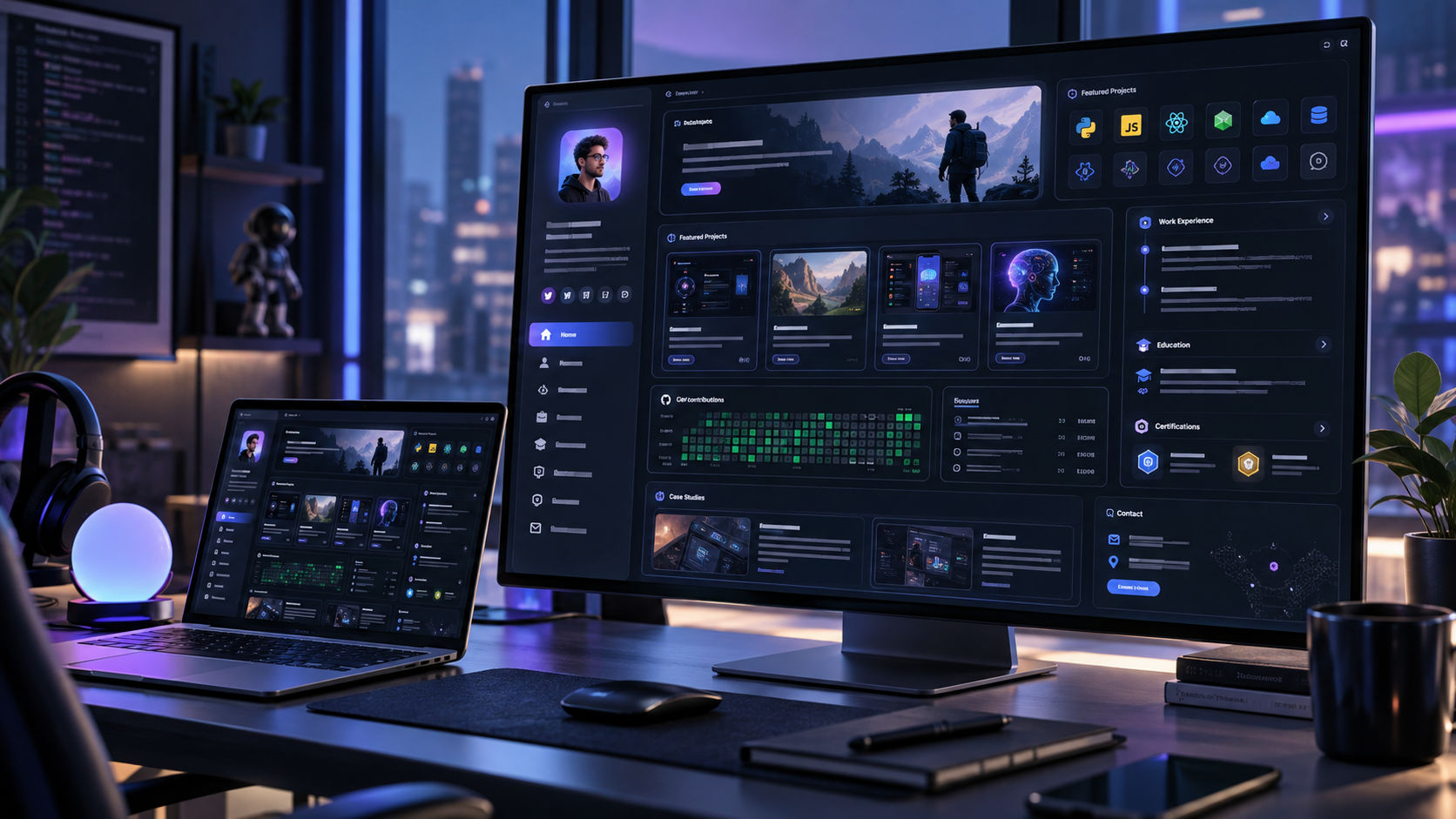
In 2026, your portfolio is your digital professional identity. It should quickly communicate who you are, what you can build, what you have worked on, and why someone should want to work with you.
Whether you're a student, freelancer, software engineer, or experienced developer, a strong portfolio should make it easy for recruiters, hiring managers, clients, and collaborators to understand your skills and experience.
So, what should a developer portfolio actually include in 2026?
Let's break it down.
1. A Clear Introduction
The first section of your portfolio should immediately answer three questions:
- Who are you?
- What do you do?
- What are you interested in building?
Your introduction doesn't need to be complicated.
Instead of simply writing:
"Hi, I'm John. I'm a software developer."
Make it more specific:
"I'm a full-stack developer building scalable web applications with TypeScript, React, and Node.js."
A good introduction gives visitors context before they explore the rest of your portfolio.
Consider including:
- Your name
- Your role or specialization
- A short professional bio
- Your location, if relevant
- A profile photo or avatar
- A clear call-to-action
Your headline should communicate your value in just a few seconds.
2. Your Best Projects
Projects are one of the most important parts of a developer portfolio.
But your portfolio shouldn't contain every project you've ever created.
Instead, showcase your strongest and most relevant work.
For each project, include:
- Project name
- Short description
- Problem it solves
- Technologies used
- Your specific contribution
- Key features
- Live demo
- Source code, when appropriate
- Screenshots or visual previews
Don't just say:
"Built a task management application using React."
Explain what makes the project interesting:
"Built a collaborative task management platform with real-time updates, role-based permissions, and optimistic UI interactions."
The goal is to demonstrate not only what you built, but also how you think as a developer.
3. A Well-Organized Tech Stack
Listing dozens of technologies doesn't automatically make a portfolio impressive.
A better approach is to organize your skills into meaningful categories.
For example:
Frontend
- React
- Next.js
- TypeScript
- Tailwind CSS
Backend
- Node.js
- Express
- PostgreSQL
- Redis
- Git
- Docker
- GitHub Actions
- AWS
Use recognizable technology icons where possible so visitors can scan your stack quickly.
Most importantly, prioritize technologies you actually use rather than listing every technology you've experimented with once.
4. Work Experience
If you have professional experience, make it easy to understand.
For each role, include:
- Company
- Job title
- Employment period
- Key responsibilities
- Major achievements
- Technologies used
Focus on outcomes instead of simply listing responsibilities.
For example:
Instead of:
Worked on the company's web application.
Try:
Developed and optimized customer-facing React applications, reducing page load time by 35% and improving the checkout experience.
Numbers and measurable outcomes can make your experience much more compelling.
5. Education
Education doesn't need to dominate your portfolio, especially once you have significant professional experience.
Keep it concise.
Include:
- Institution
- Degree
- Field of study
- Graduation year
- Relevant achievements, when useful
For students and recent graduates, this section can be more prominent.
6. Certifications and Achievements
Certifications can help demonstrate structured learning, particularly when you're early in your career.
You can include:
- Cloud certifications
- Professional certifications
- Technical certifications
- Hackathon achievements
- Competitive programming achievements
- Awards
- Notable milestones
Only include achievements that strengthen your professional story.
7. GitHub and Developer Activity
Your GitHub profile can provide additional evidence of your development experience.
Consider linking directly to your GitHub profile and highlighting meaningful repositories.
You can also showcase:
- Contribution activity
- Open-source projects
- Popular repositories
- Recent development activity
However, don't assume a large contribution graph automatically makes you a better developer.
The quality and relevance of your work matter more than the number of green squares.
8. A Strong About Section
Your About section gives visitors a chance to understand the person behind the code.
Talk about:
- Your development journey
- Areas you're interested in
- Technologies you enjoy working with
- Problems you like solving
- What you're currently learning
- What you're looking for
Keep it authentic.
Your portfolio shouldn't read like a generic resume copied into a website.
Don't make people search for a way to contact you.
Include an obvious contact option.
Depending on your goals, this could include:
- Email
- LinkedIn
- GitHub
- X or other professional social profiles
- Contact form
A simple call-to-action such as "Let's work together" or "Get in touch" can make the next step obvious.
10. A Resume
A downloadable resume is still useful in 2026.
Some recruiters and companies will want a traditional resume even if your portfolio contains the same information.
Provide a clearly visible option to:
Download Resume
Make sure your resume and portfolio tell the same professional story and are kept up to date.
11. Responsive and Accessible Design
Your portfolio isn't only being viewed on a desktop.
It should work well across:
- Phones
- Tablets
- Laptops
- Large monitors
Pay attention to:
- Typography
- Spacing
- Navigation
- Contrast
- Button sizes
- Loading performance
- Keyboard navigation
- Screen-reader accessibility
A beautiful portfolio that is difficult to use is still a bad portfolio.
Developers are expected to care about performance.
Your portfolio should load quickly and feel responsive.
Optimize:
- Images
- Fonts
- JavaScript
- Animations
- Third-party scripts
- API requests
Avoid adding animations simply because you can.
Every visual effect should have a purpose.
13. Your Personality
A developer portfolio doesn't need to look like every other developer portfolio.
Your design can communicate your personality.
You might choose:
- Minimal and professional
- Bold and experimental
- Technical and futuristic
- Playful and colorful
- Editorial and content-focused
The important thing is that the design supports your professional identity instead of distracting from it.
14. Real Proof of Your Skills
In 2026, simply claiming that you're good at something isn't enough.
Your portfolio should provide evidence.
That evidence can come from:
- Real projects
- Open-source contributions
- Case studies
- Client work
- Technical writing
- GitHub repositories
- Product launches
- Certifications
- Community contributions
Think of your portfolio as a collection of proof, not just claims.
15. Case Studies
For your most important projects, consider creating detailed case studies.
A good case study can explain:
- The problem
- Your approach
- Technical decisions
- Challenges
- Implementation
- Results
- What you learned
This gives recruiters and clients insight into your problem-solving process.
It also helps demonstrate skills that aren't obvious from a project screenshot.
16. AI and Modern Development Skills
AI has become an important part of modern software development.
If you work with AI, don't simply add "AI" to your skills section.
Show how you use it.
For example:
- AI-powered applications
- LLM integrations
- AI agents
- Retrieval-augmented generation
- Model APIs
- AI-assisted development workflows
- Evaluation systems
- Automation
A project demonstrating how you applied AI to solve a real problem is much more valuable than a generic AI badge.
17. A Portfolio That Is Easy to Explore
Your portfolio should have a clear hierarchy.
A visitor should be able to quickly move from:
Introduction → Skills → Projects → Experience → Contact
Don't bury important information behind complicated navigation.
The best portfolios make it effortless for someone to understand your professional story.
What a Developer Portfolio Should Include in 2026
At a minimum, your portfolio should contain:
- Introduction - Who you are and what you do
- Projects - Your strongest work
- Tech Stack - Your core technical skills
- Experience - Professional background
- About - Your story and interests
- Contact - How people can reach you
- Resume - Downloadable professional summary
- GitHub / Social Links - Additional proof and presence
Depending on your experience, you can also add education, certifications, case studies, open-source contributions, articles, achievements, and other custom sections.
The Goal Isn't to Include Everything
A common mistake is trying to make a portfolio as comprehensive as possible.
More information doesn't necessarily make a portfolio better.
Your goal is to create a portfolio that answers the most important questions quickly:
Who are you?
What can you build?
What have you built?
How do you solve problems?
Why should someone work with you?
If your portfolio can answer those questions clearly, you're already ahead of many developer portfolios.
Final Thoughts
A great developer portfolio in 2026 isn't simply an online resume.
It's a living representation of your skills, projects, experience, personality, and professional growth.
Focus on showing meaningful work, explaining your decisions, providing evidence of your skills, and making the experience easy to navigate.
You don't need dozens of projects or an overly complicated design.
You need a portfolio that makes your best work impossible to miss.
And most importantly, keep improving it as you grow.
Your portfolio should evolve with you.