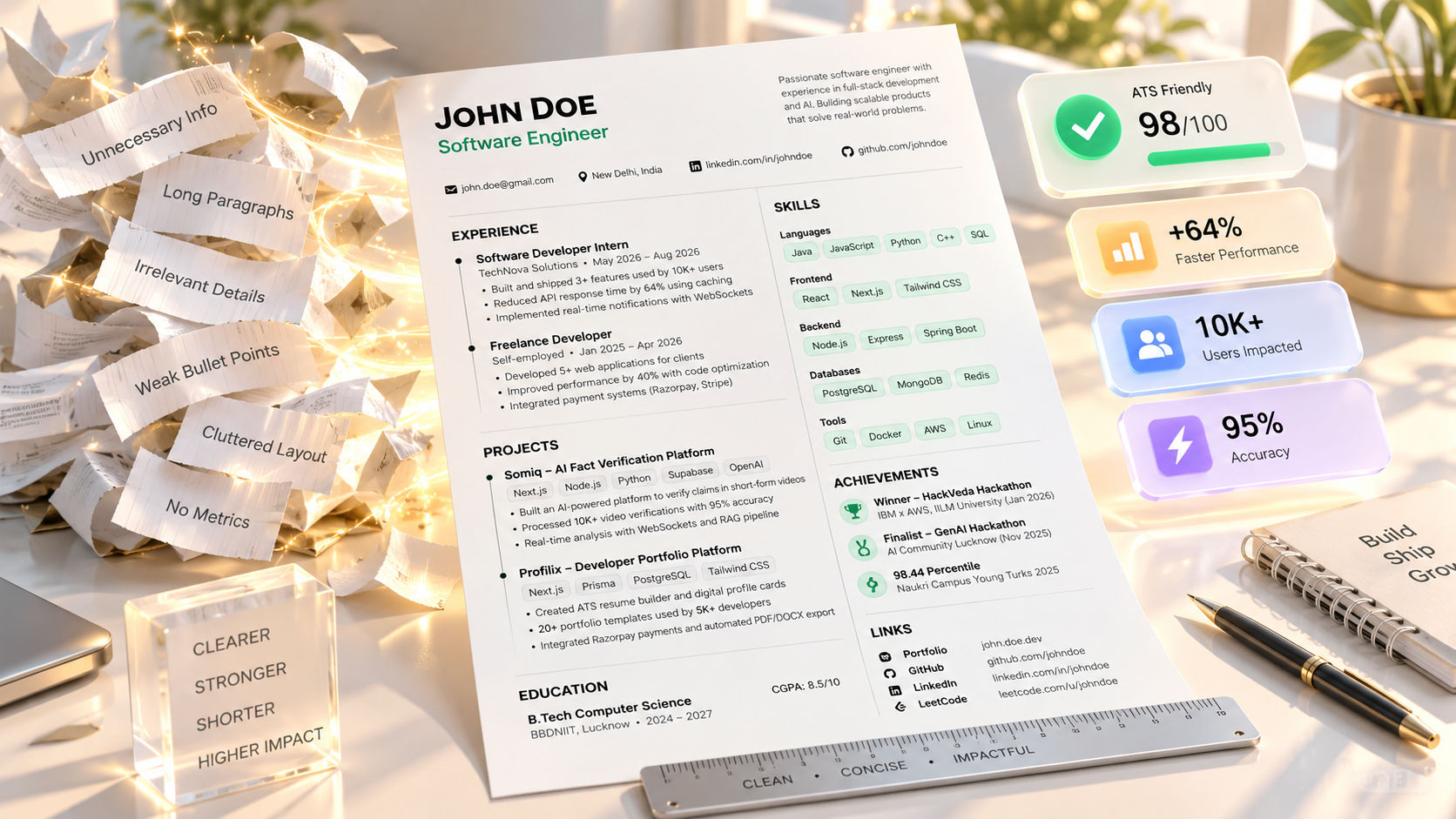
The 1-Page Software Engineer Resume: What to Keep, What to Cut, and How to Fit It
Every time you build a new side project, complete an internship, or learn a new framework, the temptation is the same: append it to your resume and let the document spill onto page two.
In software engineering, unless you are a Staff+ Engineer with 10+ years of production architecture experience or a researcher with peer-reviewed publications, a two-page resume hurts your chances more than it helps.
Why? Because technical recruiters and hiring managers care about signal density, not total volume. If you have three awesome achievements buried inside 15 mediocre bullet points across two pages, the reviewer's eyes will likely hit the mediocre ones during their 6-second scan and move on.
Think of your 1-page resume like optimizing a high-traffic API payload: strip redundant metadata, compress whitespace intelligently, and serve only high-value data. Here is the exact playbook on what to cut, what to keep, and how to fit everything cleanly onto a single page.
Before touching font sizes or margins, eliminate the sections that take up vertical lines without adding a single point to your hiring scorecard:
- The Generic "Summary" or "Objective" Paragraph: A 4-line paragraph stating "Passionate Full-Stack Engineer seeking a challenging role to leverage React and Node.js skills..." wastes 10% of your page. Unless you are making a major career pivot that requires context, delete the summary entirely and let your experience speak first.
- Soft Skills & Operating Systems: Never dedicate a line in your Skills section to "Communication, Teamwork, Leadership, Time Management" or "Windows, macOS, VS Code, Postman." Technical reviewers expect you to know how to use an IDE, and soft skills must be demonstrated inside your experience bullets, not listed as keywords.
- Full Street Addresses: Nobody is mailing you a physical offer letter. Replace your multi-line street address and postal code with just
City, Country (or Open to Relocation) on your main contact line.
- High School Education & Basic Coursework: Once you are in university or working in industry, drop your 10th/12th-grade scores and high school details. Similarly, cut freshman-level coursework like Intro to Programming—only list high-leverage subjects like Operating Systems, Distributed Systems, DBMS, or Computer Networks if they fit on a single line.
- Tutorial Clone Projects: If you have solid internships or complex full-stack/systems projects, cut the early Weather App, To-Do List, or basic E-Commerce UI Clone. Two deep, production-grade projects beat five shallow ones every time.
2. What to Keep (The High-Signal Core)
A razor-sharp 1-page software engineering resume only needs four structural blocks:
- A Single-Line Header Bar: Your name at the top, followed by a single pipe-separated line containing your phone, email, LinkedIn, GitHub, and live portfolio URL:
+91-XXXXXXXXXX | you@email.com | github.com/username | linkedin.com/in/username | yourportfolio.dev
- Experience (3 to 4 XYZ Bullets per Role): Focus on your most recent and technical roles. Cap recent internships or full-time roles at 4 bullets max, and older roles at 2 bullets. Every bullet should include a concrete metric and the tech stack used.
- 2 to 3 Standout Engineering Projects: Highlight systems you architected, hackathons you won, or open-source tools with real users. Include clickable links to the live deployment and source code right next to the project title.
- Categorized Technical Skills (3 to 4 Lines Max): Group your stack logically so both ATS parsers and human eyes can scan it in two seconds:
- Languages: C++, Java, Python, TypeScript, SQL
- Frameworks & Libraries: React, Next.js, Node.js, FastAPI, Spring Boot, Three.js
- Databases & Cloud: PostgreSQL, MongoDB, Redis, Docker, AWS, Git/GitHub Actions
3. Typography & Layout Hacks to Fit Everything cleanly
What if you have trimmed all the fluff and your resume is still overflowing by 6 lines onto page two? Do not shrink your body font size below 9.5pt. Instead, apply these spatial engineering fixes:
Hunt Down "Orphan Words" (The Fastest Space Saver)
Scan the bottom line of every single bullet point on your resume. Do you have bullets where just one or two words (like ...in production. or ...using Docker.) spill over onto a second or third line?
- Rewriting a sentence to trim 12 characters pulls that hanging word back up to the previous line—instantly saving an entire vertical row of page space without losing any technical information. Fixing five orphan lines across a resume frees up space for a whole new project.
Don't put the Company Name on line 1, Job Title on line 2, Location on line 3, and Dates on line 4. Combine them into a maximum of one or two lines using left-and-right alignment:
- Line 1: Company Name — Software Engineer Intern (Left) | June 2026 – Aug 2026 | Remote (Right)
Dial In the "Goldilocks" Margins & Spacing
Default Word and Google Docs templates use massive 1.0-inch margins that leave nearly 35% of your page blank.
- Margins: Set top/bottom and left/right margins between
0.4in and 0.5in. It keeps the page breathable while giving you ~20% more horizontal and vertical real estate.
- Font Size: Keep body bullets at
9.5pt to 10.5pt, section headers at 11pt to 12pt, and your name at 18pt to 20pt.
LaTeX Spacing Configuration (For Overleaf Users)
If you compile your resume in LaTeX (such as Jake's Resume template), use the enumitem package to tighten vertical gaps between list items without squishing line height inside paragraphs:
\usepackage{enumitem}
\usepackage[margin=0.45in]{geometry}

% Tighten spacing between bullet points and sections
\setlist[itemize]{itemsep=1pt, topsep=2pt, parsep=0pt, partopsep=0pt}
\titlespacing*{\section}{0pt}{6pt}{3pt}
The 6-Second Squint Test
Once your resume fits on a single page, zoom out to 75% on your monitor and step back for six seconds:
- Can you immediately tell what your strongest programming languages are?
- Do numbers and percentages (
60%, 300ms, 10k+ users) jump out visually inside your experience bullets?
- Is there enough whitespace between sections so the page doesn't look like a solid wall of black ink?
When every single line on your 1-page resume earns its pixel space, recruiters don't have to hunt for reasons to interview you—every place their eyes land is a highlight.