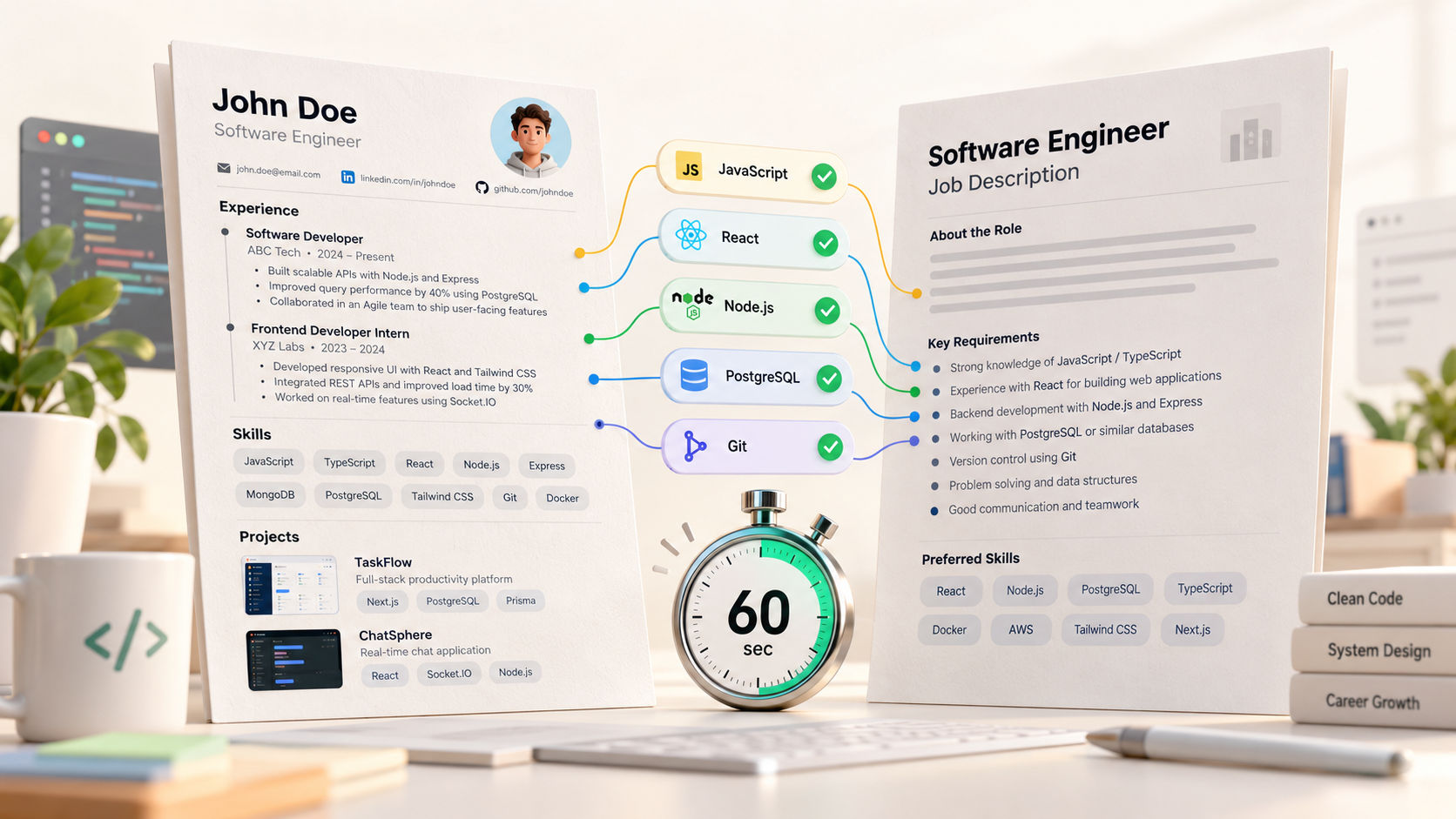
How to Tailor Your Developer Resume to Any Job Description in Under 60 Seconds
Applying for software engineering jobs can feel like a numbers game. You find an interesting opening, update your application, submit your resume, and move on to the next one. After a few applications, the process becomes repetitive.
But there is a problem with sending the same resume everywhere: different jobs prioritize different skills, even when they share the same title.
A backend role might prioritize Java, Spring Boot, SQL, and API design. A full-stack position might emphasize React, Node.js, TypeScript, and database integration. Sending an identical resume to both employers can make your most relevant experience harder to spot.
The good news? You don't need to rewrite your resume from scratch for every application.
With a structured approach, you can identify the most important requirements, select your strongest matching experience, and adjust your resume in about 60 seconds.
In this guide, you'll learn exactly how to do it, with practical examples for software engineers, full-stack developers, freshers, and experienced professionals.
Why You Should Tailor Your Developer Resume
Recruiters need to understand quickly whether your experience matches the role. A tailored resume helps them find that connection without digging through unrelated information.
Consider these two job descriptions:
Job A: Backend Software Engineer
- Java and Spring Boot
- REST API development
- PostgreSQL and database optimization
- Unit testing
- Docker
Job B: Frontend Software Engineer
- React and TypeScript
- Responsive UI development
- State management
- API integration
- Web performance
Imagine that you have experience with both backend and frontend development. Your underlying skills haven't changed, but the most relevant parts of your experience are different for each application.
For Job A, your Spring Boot API project should appear prominently. For Job B, your React application and frontend achievements deserve more attention.
Tailoring your resume makes the connection between your experience and the employer's requirements easier to see.
It can also help align your resume with the keywords used in a job description. However, no keyword strategy guarantees that an ATS will accept your resume or that a recruiter will shortlist you.
The 60-Second Developer Resume Tailoring Method
You can use this workflow whenever you find a job worth applying for.
Seconds 0–10: Identify the Core Requirements
Read the job description and identify the most important technical requirements.
Look for:
- Programming languages
- Frameworks and libraries
- Databases
- Engineering practices
- Responsibilities
- Required experience level
Don't try to memorize every word. Focus on the requirements that appear central to the position.
For example, if a listing repeatedly mentions Java, Spring Boot, REST APIs, PostgreSQL, and testing, those are likely important signals.
Seconds 10–20: Find the Matching Keywords
Identify a small group of relevant keywords from the job description.
A useful starting point is to separate them into three categories:
| Category | Example keywords |
|---|---|
| Core technologies | Java, Spring Boot, PostgreSQL |
| Engineering skills | REST APIs, unit testing, debugging |
| Supporting tools | Git, Docker, Maven |
Prioritize the requirements that are essential to the role rather than trying to include every term in the listing.
Important: Only include technologies and skills you genuinely understand or have used. Never claim a skill just because it appears in a job description.
Seconds 20–35: Select Your Most Relevant Experience
Look through your existing resume and identify the strongest evidence that matches the requirements.
This could be:
- A professional experience bullet
- A completed internship
- A personal project
- An open-source contribution
- A relevant academic project
Suppose the job asks for REST APIs and PostgreSQL. A project where you implemented API endpoints and designed database tables is more relevant than an unrelated static website.
Move the relevant experience higher within the appropriate section if doing so improves clarity. You don't need to invent new achievements or remove useful information just to match the listing.
Seconds 35–50: Improve One or Two Bullet Points
Rewrite the most relevant bullet points to explain your contribution in the language of the job description.
Before:
Worked on a web application using Java and SQL.
After:
Developed REST APIs using Java and Spring Boot, integrating PostgreSQL to support application data management.
The revised bullet is more specific, communicates what you built, and naturally includes relevant technologies.
If you have a verified result, include it:
Optimized PostgreSQL queries and indexes, reducing average endpoint response time from 380 ms to 240 ms in benchmark tests.
Only use measurable outcomes that you can substantiate.
Seconds 50–60: Check and Export
Perform a quick final review:
- Does the summary match the target role?
- Are the most relevant skills easy to find?
- Do the strongest matching projects appear prominently?
- Are the keywords used naturally and truthfully?
- Does the exported resume retain its formatting?
Save a separate version for the application if you need to preserve your original resume.
That's the complete workflow. The 60-second target is a practical editing goal, not a guarantee that every application can be fully optimized in that time. Complex or senior positions may require more careful review.
A Practical Example: Tailoring a Full-Stack Developer Resume
Let's say your existing resume describes you as a full-stack developer with experience in React, Node.js, Express, PostgreSQL, Java, and Docker.
You're applying for this position:
Job title: Backend Software Engineer
Key requirements:
- Node.js and Express
- REST API development
- PostgreSQL
- Authentication and authorization
- Automated testing
Your existing resume contains this project bullet:
Built a full-stack web application using React, Node.js, Express, PostgreSQL, and Tailwind CSS.
It's accurate, but it doesn't explain which parts of the application demonstrate your backend skills.
A more targeted version would be:
Developed REST APIs using Node.js and Express, implemented authentication middleware, and integrated PostgreSQL for persistent application data.
If you also wrote automated tests, you could add:
Added automated tests for API validation and authentication flows to verify expected behavior and handle invalid requests.
These revisions make your relevant experience easier to identify without changing the underlying facts.
What should you change for a frontend role?
For a React-focused position, emphasize the frontend contribution instead:
Built reusable React components and responsive interfaces, integrated backend APIs, and implemented loading and error states for key user workflows.
The project remains the same. The emphasis changes to reflect the role.
This is the core principle of resume tailoring: change the presentation of your relevant experience, not the truth of your experience.
Use AI to Speed Up Resume Tailoring
You can use an AI assistant to compare a job description with your existing resume, identify missing keywords, and suggest improvements to relevant bullet points.
The key is to give it both documents and clear instructions about accuracy.
Here's a reusable prompt you can copy.
Copy-Paste Resume Tailoring Prompt
You are an experienced technical recruiter and resume editor.

I will provide:
1. A software engineering job description.
2. My existing resume.

Your task is to help me tailor my resume to the role.

Follow these rules:

1. Identify the 8 most important skills and requirements
   in the job description.
2. Compare them with my existing resume.
3. Classify each requirement as:
   - Demonstrated in my resume
   - Partially demonstrated
   - Not demonstrated
4. Recommend the 3 most relevant projects or experience
   bullets to prioritize.
5. Rewrite up to 3 existing bullets for clarity and relevance.
6. Suggest a concise professional summary for the target role.
7. Preserve my actual experience, skills, dates, and results.
8. Never invent achievements, metrics, employers, or skills.
9. Do not add keywords unless my experience supports them.
10. Keep the resume readable and suitable for ATS parsing.

Return:
A. The highest-priority job requirements.
B. A keyword match table.
C. The recommended edits.
D. The revised summary and bullet points.
E. A final accuracy checklist.

JOB DESCRIPTION:
[Paste the complete job description here]

MY RESUME:
[Paste your resume here]
This prompt works for a wide range of technical roles, including frontend development, backend engineering, full-stack development, Java development, and entry-level software engineering.
Review the suggested edits before using them. AI-generated recommendations can misunderstand technical details or suggest keywords that don't accurately describe your work.
What About ATS Keyword Matching?
Applicant Tracking Systems are not all identical. Some parse resumes into structured fields, some support keyword searches, and some are part of broader screening workflows.
Tailoring your resume can improve the relevance of its content, but there is no universal ATS score or guaranteed keyword threshold.
Use these guidelines to make your resume easier to understand and process.
Use the same terminology when appropriate
If the job description asks for "REST API development" and your experience genuinely includes REST APIs, use that terminology rather than an unnecessarily vague phrase such as "backend communication."
If an employer uses a particular framework name, mention it when it accurately reflects your experience.
Include both abbreviations and full terms when useful
For example:
- CI/CD (continuous integration and continuous delivery)
- Object-oriented programming (OOP)
- Application Programming Interfaces (APIs)
You don't need to repeat every term in multiple forms. Use the terminology that makes your skills clear to both humans and software.
Keep keywords in context
A skills section can list relevant technologies, but your experience and project sections should demonstrate how you used them.
For example, listing PostgreSQL is useful. Explaining that you designed relational schemas, wrote SQL queries, or optimized indexes provides more context.
Don't chase a perfect ATS score
A numerical score from a resume tool is an estimate based on that tool's own criteria. It is not a universal measurement of interview probability.
Focus on relevance, accuracy, readable formatting, and clear evidence of your capabilities.
How to Tailor Your Resume for Different Developer Roles
Use this reference when deciding which parts of your resume deserve the most attention.
| Target role | Skills to emphasize | Strong evidence |
|---|---|---|
| Frontend developer | React, TypeScript, accessibility, performance | Responsive interfaces, reusable components |
| Backend developer | Java, Node.js, APIs, databases, testing | API design, data modeling, reliability |
| Full-stack developer | Frontend, backend, databases, deployment | End-to-end application features |
| Java developer | Core Java, Spring Boot, SQL, JUnit | Backend services and tested business logic |
| Python developer | Python, FastAPI, Django, SQL | APIs, automation, data processing |
| DevOps-oriented engineer | Docker, CI/CD, Linux, cloud tools | Automated pipelines and reliable deployments |
| Entry-level engineer | Programming fundamentals, projects, Git | Personal projects, internships, coursework |
| Senior engineer | Architecture, ownership, reliability, mentoring | System improvements and technical leadership |
Use this table as a starting point rather than a fixed checklist. Actual requirements vary by employer and seniority.
Common Resume Tailoring Mistakes
Tailoring should make your resume more relevant, not less credible.
Avoid these common mistakes.
1. Copying every keyword from the job description
Adding dozens of unrelated technologies can make your resume difficult to read. Prioritize requirements that match your actual experience.
2. Rewriting your entire resume for every application
You usually need to update only the summary, skills ordering, and a few relevant experience or project bullets. Keep a strong master resume as your starting point.
3. Exaggerating your experience
Don't turn basic exposure to a framework into advanced production experience. Recruiters may ask detailed questions about anything you claim.
4. Removing useful achievements
Don't remove a meaningful accomplishment simply because it doesn't contain an exact keyword from the listing. Relevant problem-solving ability and demonstrated impact still matter.
5. Ignoring the human reader
A resume should make sense to a recruiter or engineering manager, not just a keyword-matching system. Use complete, specific statements instead of awkward lists of technologies.
6. Forgetting to review the final file
Always check the final PDF or DOCX, especially after changing the order of sections or exporting from a resume builder.
Build a Resume You Can Tailor Quickly
The easiest way to tailor your resume efficiently is to start with a well-organized base document.
Keep your technical skills accurate, maintain a collection of strong project descriptions, and record the results of your work as you gain experience. Then you can select the most relevant information for each role without rebuilding everything.
Profilix can help you create a professional developer resume and present your skills and projects in a structured format.
A simple process works well:
- Build your core resume once.
- Save accurate descriptions of your strongest projects and achievements.
- Review the job description before applying.
- Prioritize the most relevant skills and evidence.
- Check the final document before submitting it.
If you apply regularly, this approach can save time while keeping each application focused on the opportunity.
Final Takeaway
Tailoring your developer resume doesn't have to mean rewriting every section for every job.
Spend a few seconds identifying the role's core requirements, find the strongest evidence in your existing resume, refine the most relevant bullet points, and review the final document.
With a clear base resume and a repeatable workflow, you can make meaningful adjustments in about a minute for straightforward applications.
The goal isn't to make your resume match every job description. It's to help the right employer quickly understand why your real skills and experience make you a relevant candidate.
Ready to create a resume that's easier to customize? Visit Profilix to get started.
Note: Resume tailoring can improve relevance and clarity, but it cannot guarantee ATS acceptance, a particular ATS score, or an interview. Always verify that your resume accurately reflects your experience.